Best walkers under $100
A hundred dollars is roughly three times what a good walker costs. At this budget the risk is not buying cheap, it is buying the wrong type or the wrong height.
By Selena H. · Last checked November 26, 2026 · How we keep pages current
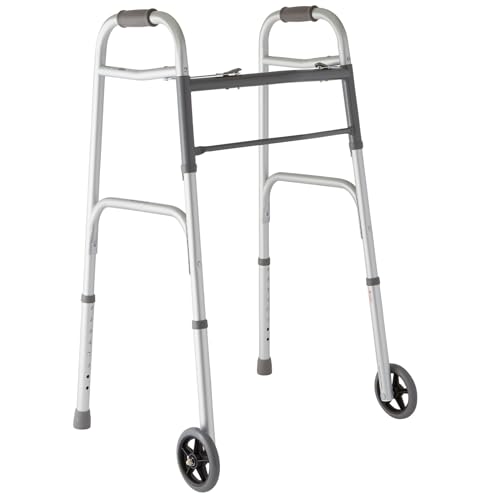
Buy the Medline Lightweight Two-Button Folding Walker with 5-inch wheels for most people: a 300 lb aluminum frame that weighs about six pounds, adjusts from 32 to 38 inches, and rolls at the front while the rear legs still grip. If balance genuinely fails rather than simply tires, buy the Drive Medical 2-Button Standard Foldable Walker instead - no wheels at all, rated to 350 lb, and the cheapest thing on this page.
The honest truth about this price band is that it is not a compromise. A good folding walker costs well under half of a hundred dollars, so the whole category sits inside the budget with room to spare, and the three or four models worth owning are all here. Spending two hundred dollars on a walker buys a rollator - a different tool, with wheels, brakes and a seat - not a better frame.
Which means the money is not the decision. Three other things are, and they are the reason walkers get returned or left in a hallway: the type, which depends on whether balance fails or stamina does; the handle height, which almost everyone sets too high; and the width, because a walker that does not pass the bathroom door is useless where it is needed most. All three are below.
We have not used these ourselves. Every figure comes from the manufacturer or the retailer listing and is attributed as such, and availability was checked on Amazon before publishing. If you are not certain which type is right, this is one of the few purchases on this site where a professional opinion genuinely matters: a physical therapist watching somebody walk for two minutes will know, and the wrong type here raises fall risk rather than lowering it.
This is general information about products, not medical advice. Talk to your doctor or occupational therapist about your own situation.
Some links on this page go to Amazon. If you buy something, we may earn a small commission at no extra cost to you — it never changes which products we pick or the order they appear in. Full disclosure.
Five frames, five different walkers
A walker is covered durable medical equipment under Medicare Part B when a doctor prescribes it for use in the home - unlike shower chairs and most bathroom equipment. If a doctor is already involved, ask before paying out of pocket.
Quick picks
Ranked for how little strength, eyesight or patience they need — not for how much they cost.
| # | Product | Best for | Score | Price |
|---|---|---|---|---|
| 1 | Medline Lightweight Two Button Folding Walker with 5" WheelsThe walker to buy unless something specific rules it out: light enough to lift, rated to 300 lb, and the two front wheels remove most of the effort without removing the stability. | The general answer - wheels at the front, grip at the back | 9.0 | $37.99 · View on Amazon #ad Price as of November 28, 2026. How we earn |
| 2 | 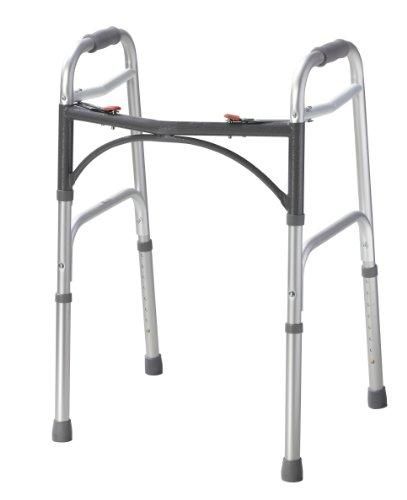 Drive Medical 2-Button Standard Foldable WalkerNo wheels, four rubber-tipped legs and a 350 lb rating. The right buy when the frame has to take genuine weight, and the lowest price on the page. | Real instability - and the cheapest frame here | 8.8 | $35.89 · View on Amazon$48.13(25% off) #ad Price as of November 28, 2026. How we earn |
| 3 | 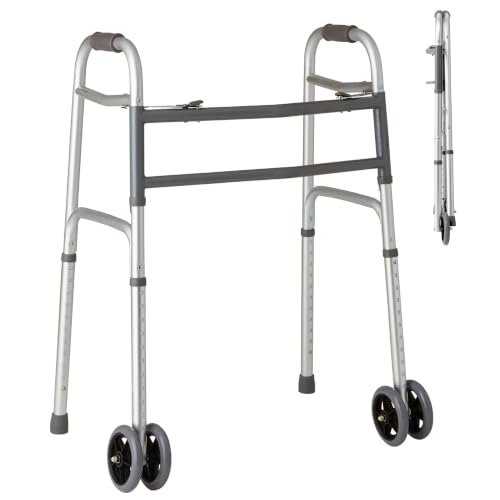 Medline Heavy-Duty Bariatric Two-Button Folding WalkerA 500 lb rating, a 20.5-inch grip width and height up to 43.5 inches - the frame to buy when a standard walker is out of its rating or too narrow. | Above a standard weight rating, or needing a wider frame | 8.6 | $54.39 · View on Amazon$63.99(15% off) #ad Price as of November 28, 2026. How we earn |
| 4 | 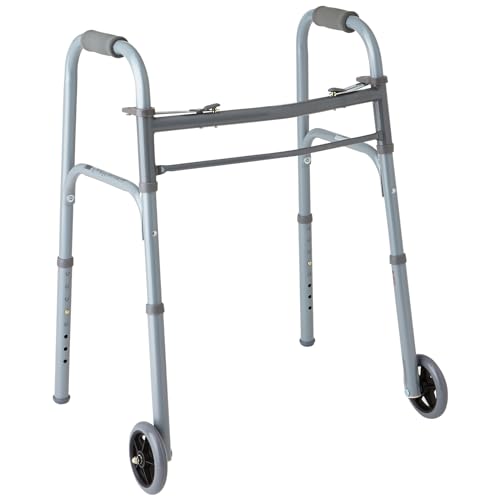 Medline Lightweight Junior/Lower Height Folding Walker with 5" WheelsThe same walker in a shorter frame - 25 to 32.5 inches of handle height, for adults the standard size leaves stooping. | A user under about 5 ft 5 in | 8.6 | $37.99 · View on Amazon #ad Price as of November 28, 2026. How we earn |
| 5 | 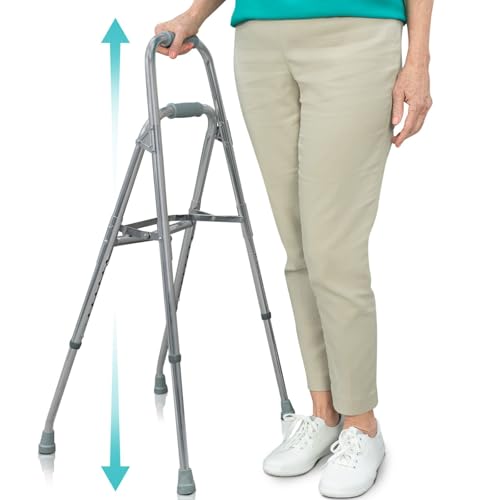 Vive Hemi WalkerHalf a walker, used in one hand: more support than a cane, narrow enough for a hallway, and genuinely useful as something to push up from. | One working hand, or a stand-assist beside a chair | 8.2 | $54.99 · View on Amazon #ad Price as of November 28, 2026. How we earn |
Tap any row to jump to the full write-up. The price button goes to Amazon.
Pick by what’s hard
Most lists sort by price. That is not how this decision actually gets made, so here it is sorted by the thing that is getting in the way.
- Balance genuinely fails, not just stamina
- Drive Medical 2-Button Standard Foldable Walker — buy the frame with no wheels. The whole value of a standard walker is that nothing moves until it is lifted, which is what lets somebody put their full weight through the handles and trust it.
- Under about five foot five
- Medline Lightweight Junior/Lower Height Folding Walker with 5" Wheels — buy the lower-height frame rather than a standard one on its lowest setting. A walker set too high pushes the shoulders up and tips the body backward, and it is the most common reason a new walker gets abandoned.
- Above a standard 300 to 350 lb rating
- Medline Heavy-Duty Bariatric Two-Button Folding Walker — buy on the published rating, not on how solid a cheaper frame looks. Frames fail suddenly rather than gradually, and the wider grip spacing also buys a normal stride.
- Only one working hand
- Vive Hemi Walker — a hemi walker is the right tool - four feet, one handle, far steadier than a cane. Expect it to cover a house rather than a walk round the block.
- Lifting the frame is getting too tiring
- Medline Lightweight Two Button Folding Walker with 5" Wheels — move to two front wheels rather than to a rollator. The wheels take out the lifting while the rear rubber tips still grip when weight goes on, which a rollator's four wheels do not.
How we picked
We don’t run a product lab. Every pick here is chosen by reading the things that actually tell you whether something works for weak hands, poor eyesight or shaky fingers: the manufacturer’s own specifications, the retailer listing, the measurements and weights, and what owners report in their reviews — especially the one-star ones. We read the complaints before the praise.
Prices change constantly, so we send you to Amazon to see today’s price rather than printing a number that goes stale. More about how we choose.
The picks in full
1. Best for the general answer - wheels at the front, grip at the back
Medline Lightweight Two Button Folding Walker with 5" Wheels
Medline · 9.0/10 on our rubric
#ad Price as of November 28, 2026. How we earn
The walker to buy unless something specific rules it out: light enough to lift, rated to 300 lb, and the two front wheels remove most of the effort without removing the stability.
A two-wheel walker is the shape that suits the most people, and it is worth understanding why rather than taking it on trust. The front legs carry 5-inch wheels so the frame rolls forward as you walk instead of being picked up and placed with every step. The rear legs keep rubber tips on the floor, so when weight goes onto the handles the back of the frame bites and the walker does not run away. You get most of a rollator's ease with none of its tendency to roll out from under somebody who leans hard.
Medline's listing puts the aluminum frame at 300 lb capacity with side cross braces, a weight of about six pounds, push-button height adjustment from 32 to 38 inches, and a stated user height range of 5 ft 5 in to 6 ft 4 in. Those last two numbers are the ones to check against the actual person before ordering, because they are the difference between a walker that helps and a walker that makes somebody stoop.
Six pounds matters more than it sounds. A walker gets lifted in and out of a car, over a threshold strip and around a toilet, and every one of those movements is done by the person who is already unsteady. The two-button fold - a button on each side, operated independently - is also the easiest folding mechanism in this category to work with weak hands or one hand, because neither button needs a pinch grip.
The reservation is the hand grips. They are ergonomic plastic, which is fine for most people and uncomfortable for anybody with real arthritis or a painful wrist. Foam grip covers cost a few dollars and solve it, and they are the first accessory we would add.
Good
- 5-inch front wheels roll, rear legs grip under weight
- 300 lb capacity with side cross braces, per Medline
- About six pounds - genuinely liftable by the person using it
- Push-button fold on each side, operable with weak hands
- 17-inch width between grips, per the listing - room for a natural stride
Watch out for
- Stated user height range starts at 5 ft 5 in - too tall for many women
- Plastic grips are hard on arthritic hands; add foam covers
- No seat and no brakes - that is a rollator, not a walker
- The front wheels can catch on deep pile carpet
| Type | Two-wheel folding walker |
|---|---|
| Capacity | 300 lb (manufacturer) |
| Frame | Aluminum with side cross braces |
| Weight | About 6 lb (manufacturer) |
| Height range | 32" - 38", for users 5'5" - 6'4" |
| Grip width | 17 inches between grips |
How it scores
- Stability under weight8.4
- Effort per step8.8
- Easy to lift and fold9.2
- Value9.6
2. Best for real instability - and the cheapest frame here
Drive Medical 2-Button Standard Foldable Walker
Drive Medical · 8.8/10 on our rubric
#ad Price as of November 28, 2026. How we earn
No wheels, four rubber-tipped legs and a 350 lb rating. The right buy when the frame has to take genuine weight, and the lowest price on the page.
This is the walker for somebody whose balance actually fails rather than somebody who gets tired. With no wheels, nothing about the frame moves until it is deliberately lifted and placed, which means a person can put their whole weight through the handles and trust it absolutely. That trust is the entire point, and it is why physical therapists still hand out standard frames when a rollator would be easier.
Drive Medical's listing describes aluminum construction supporting up to 350 lb, four rubber-tipped legs, a U-shaped frame for greater clearance, and a weight of about six pounds. The cross-frame design is the detail worth noticing: it lets the walker come closer to the body than an older square frame, which is what makes standing up out of a chair into the walker possible rather than a lunge.
The cost is pace and arms. Lift, place, step, step, lift. It is slower and more tiring than anything with wheels, and it uses shoulders that may not have much to give. For a short distance inside a house that is a fair trade; for walking to a mailbox at the end of a drive it is often the reason somebody stops going.
Two practical notes. The rubber tips are consumable - check them every few months and replace them when the tread flattens, because a hardened tip on a tile floor is a slip waiting to happen. And if lifting the frame proves too much after a week or two, the fix is glide caps or a wheel kit rather than a different walker.
Good
- Nothing rolls - full weight can go through the handles
- 350 lb capacity, the highest of the standard-width frames here
- U-shaped frame and cross-frame design bring it close for standing up
- About six pounds, aluminum, folds with a button on each side
- The cheapest walker on this page
Watch out for
- Has to be lifted with every step - slow and tiring on the arms
- Rubber tips wear out and must be replaced, not ignored
- Not the choice for long distances or outdoors
- Height range is not stated in the listing - check it against the wrist test below
| Type | Standard folding walker, no wheels |
|---|---|
| Capacity | 350 lb (manufacturer) |
| Frame | Aluminum, U-shaped, cross-frame |
| Weight | About 6 lb (manufacturer) |
| Feet | Four rubber tips |
How it scores
- Stability under weight9.6
- Effort per step5.6
- Easy to lift and fold9.0
- Value9.6
3. Best for above a standard weight rating, or needing a wider frame
Medline Heavy-Duty Bariatric Two-Button Folding Walker
Medline · 8.6/10 on our rubric
#ad Price as of November 28, 2026. How we earn
A 500 lb rating, a 20.5-inch grip width and height up to 43.5 inches - the frame to buy when a standard walker is out of its rating or too narrow.
Standard walkers are commonly rated to 300 or 350 lb. Above that, the correct purchase is not a sturdier-looking standard frame but a bariatric one, and the reason is worth being blunt about: frames do not fail gradually. A walker used over its rating is fine for months and then is not, usually at the worst possible moment. Medline rates this one to 500 lb.
The second thing it buys is room. The listing gives 20.5 inches between the grips against 17 inches on the standard model, which is the difference between walking inside the frame and shuffling through it. For a wider person that extra three and a half inches is what makes a normal stride possible, and an abnormal stride is itself a fall risk.
It also goes taller than anything else here: 33.5 to 43.5 inches of handle height by Medline's figures, which covers tall users that the standard frame tops out below. If somebody over about six foot four has been stooping over a walker, this is the fix, regardless of their weight.
The costs are weight and width. At about eleven pounds it is nearly twice the standard frame, which matters every time it goes in a car. And an extra-wide walker has to get through the doorways in the house it will live in - measure the bathroom door first, because that is the narrowest opening in most homes and the one place a walker is most needed.
Good
- 500 lb capacity, per Medline
- 20.5 inches between grips - room for a natural stride
- Handle height to 43.5 inches, the tallest range here
- 5-inch front wheels, two-button fold, aluminum frame
Watch out for
- About 11 lb - nearly twice the standard frames
- Extra width means measuring the bathroom doorway before ordering
- Heavier to lift in and out of a car trunk
| Type | Bariatric two-wheel folding walker |
|---|---|
| Capacity | 500 lb (manufacturer) |
| Weight | About 11 lb (manufacturer) |
| Height range | 33.5" - 43.5" |
| Grip width | 20.5 inches between grips |
How it scores
- Stability under weight9.4
- Effort per step8.2
- Easy to lift and fold6.6
- Value9.0
4. Best for a user under about 5 ft 5 in
Medline Lightweight Junior/Lower Height Folding Walker with 5" Wheels
Medline · 8.6/10 on our rubric
#ad Price as of November 28, 2026. How we earn
The same walker in a shorter frame - 25 to 32.5 inches of handle height, for adults the standard size leaves stooping.
This is the pick nobody tells people about, and it quietly fixes the most common complaint in the category. Standard adult walkers start at about 32 inches of handle height and are sized for users from roughly 5 ft 5 in upward. A very large number of the people who need a walker - older women in particular - are shorter than that, and a frame set at its lowest hole is still too tall for them.
The consequence is not a minor discomfort. A walker set too high pushes the shoulders up and the elbows out, which takes the weight off the legs in the wrong direction, tires the arms within a block and tips the body backward instead of forward. People describe it as the walker fighting them, and they are right.
Medline's junior frame adjusts from 25 to 32.5 inches and the listing gives a user height range of 4 ft 6 in to 5 ft 5 in. It is steel rather than aluminum, which costs a pound - about seven pounds total - and buys a 400 lb rating, higher than the standard aluminum model. Grip width is 17.5 inches, essentially the same as the adult frame, and the 5-inch front wheels and two-button fold are identical.
One word on the name: it is sold as a junior or youth walker and that labeling puts people off. It is the same product in a shorter size, and for an adult under about five foot five it is simply the correct one.
Good
- Handle height from 25 inches - genuinely fits a short adult
- 400 lb capacity on a steel frame, per Medline
- Same 5-inch wheels and two-button fold as the adult model
- About seven pounds, so still easy to lift
Watch out for
- Marketed as a junior/youth walker, which puts adults off unnecessarily
- Tops out at 32.5 inches - no use for a taller user
- Steel rather than aluminum, so a pound heavier than the standard frame
| Type | Two-wheel folding walker, lower height |
|---|---|
| Capacity | 400 lb (manufacturer) |
| Frame | Steel with side cross braces |
| Weight | About 7 lb (manufacturer) |
| Height range | 25" - 32.5", for users 4'6" - 5'5" |
| Grip width | 17.5 inches between grips |
How it scores
- Stability under weight8.6
- Effort per step8.8
- Easy to lift and fold8.8
- Value9.4
5. Best for one working hand, or a stand-assist beside a chair
Vive Hemi Walker
Vive Health · 8.2/10 on our rubric
#ad Price as of November 28, 2026. How we earn
Half a walker, used in one hand: more support than a cane, narrow enough for a hallway, and genuinely useful as something to push up from.
A hemi walker exists for the person a normal walker does not fit - usually after a stroke, or with one arm in a sling, or with a shoulder on one side that cannot take any load. It is a four-footed frame with a single handle, held in one hand, and it sits in the gap between a cane and a full walker: far more stable than a cane, far less demanding than a two-handed frame.
Vive gives the footprint as 18 inches wide by 17 inches deep, a 300 lb capacity, non-slip rubber tips, and a frame weight of about four pounds - the lightest thing on this page by a wide margin, and one-handed lifting is exactly what it is for. Height adjusts in one-inch increments and it arrives assembled.
The second use is the one owners talk about most. Stood in front of a chair, a couch or a toilet, it becomes something solid to push up from, which is a problem most houses solve badly with a wobbly side table. Vive explicitly suggests it as a stand-assist and as a grab bar substitute in a bathroom, and that is a reasonable use for a 300 lb frame on rubber feet - though it is standing on the floor, not fixed to the wall, so it is not a replacement for a properly anchored grab bar when somebody is pulling sideways.
The limitation is distance. One hand means one side is supported and the other is not, so a hemi walker is a short-distance device for moving around a home. It also asks more of balance than a two-handed frame does, which is why it is prescribed rather than chosen in most recoveries.
Good
- Used in one hand - the answer after a stroke or with one usable arm
- About four pounds, the lightest frame here
- Narrow 18" x 17" footprint for hallways and bathrooms
- Doubles as something solid to push up from beside a chair
- Arrives assembled, adjusts in 1-inch steps
Watch out for
- Supports one side only - short distances, not walks
- Asks more of balance than a two-handed walker
- Not a substitute for a wall-anchored grab bar when pulling sideways
- 300 lb capacity, lower than the bariatric frame above
| Type | Hemi walker, one-handed |
|---|---|
| Capacity | 300 lb (manufacturer) |
| Weight | About 4 lb (manufacturer) |
| Footprint | 18" wide x 17" deep |
| Height | Adjustable in 1-inch increments |
How it scores
- Stability under weight7.4
- Effort per step7.0
- Easy to lift and fold9.6
- Value8.8
Set the handle height before the first step
- Put the walker on a level floor and have the person stand inside it, upright, wearing the shoes they actually wear.
- Let both arms hang straight down and relaxed at the sides.
- The handle should sit level with the crease of the wrist. That is the target - not the knuckles, not the palm.
- Adjust all four legs to the same hole and count the holes rather than eyeballing it. An uneven frame rocks.
- Check the elbows now bend about 15 to 20 degrees when the hands are on the grips. Straight arms means too low; raised shoulders means too high.
- Push down hard on each handle in turn, and listen for a click or look for the button sitting flush, before anybody trusts it with their weight.
This is the step almost everybody skips, and it is worth more than the difference between any two walkers on this page. The method takes a minute and needs no tools.
If the person has had a hip or knee replacement, their discharge instructions may specify a height or a walking pattern. That overrides everything here - ask the physical therapist.
What a hundred dollars cannot buy here
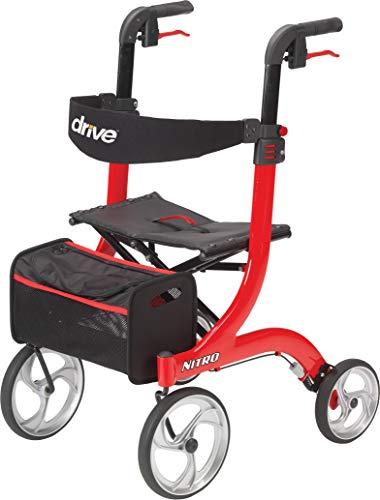
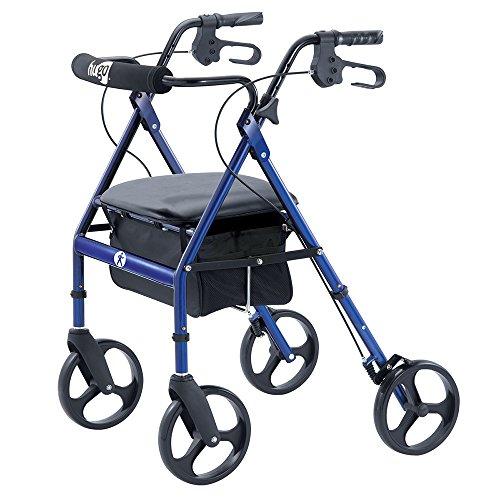
A seat, brakes and four wheels. That combination is a rollator, which is a different tool for a different problem: it rolls continuously, it does not take full body weight because it moves when you lean, and it exists for stamina rather than instability. Our rollators under $200 roundup covers that side, and our walker versus rollator comparison is the page to read if you are genuinely unsure which you need - it is the most consequential choice in this section and the one most often made on price.
What a hundred dollars also does not buy is a lighter frame than six pounds. Carbon-fiber and ultra-light folding walkers exist above this price, and they save perhaps two pounds. For somebody who lifts the frame into a car several times a day that is real; for most households it is not.
And it does not buy a walker that handles a lawn, gravel or a grass verge. Five-inch wheels and rubber tips are indoor and sidewalk equipment. Outdoor ground needs the eight- to ten-inch wheels that only appear on rollators, which is a reason to read that page rather than to spend more here.
Wheels, glides or neither
Every frame on this page is sold in a wheeled or an unwheeled configuration, and the choice is reversible for a few dollars, which is worth knowing before anybody buys a second walker.
No wheels is maximum grip and maximum effort: four rubber tips that hold the floor completely. Two front wheels keep the rear tips gripping while removing the lift from each step, which suits most people. Glide caps - plastic or nylon skis that replace the rear tips - let the back of the frame slide rather than being lifted, which is a middle option for somebody who cannot lift but needs more resistance than wheels allow. Four wheels on a walker frame is not a configuration to buy; that is a rollator and it needs brakes.
On the tennis balls you have seen in care homes: they work, they are cheaper than glide caps, and they are also unregulated, collect grit that scratches floors, and hide the wear you are supposed to be checking. Proper glide caps cost a few dollars a pair and are the better answer.
Replace rubber tips and glide caps when the tread flattens, not when they look dirty. A hardened tip on tile is one of the most reliable slip risks in a house.
Measure two doorways before you order
A walker's useful width is the outside of its back legs, and the two openings that decide whether it works are almost never the front door. The first is the bathroom door, because that is the narrowest opening in most houses and the place where a walker is needed most. The second is the turn at the end of a hallway, where a frame has to pivot rather than pass straight through.
Standard-width frames here sit at roughly 17 to 17.5 inches between the grips, with the legs a little wider. The bariatric frame is 20.5 inches between grips, which is where doorway problems start. If the bathroom door is a 24-inch opening - common in houses built before the 1970s - measure it properly before paying for the wider frame.
If the frame will not fit, the fix is usually not a different walker. Removing a door and fitting a curtain, or swapping the hinges for offset hinges that gain about two inches, costs very little and solves it permanently.
Spend the change on these three things
There is money left over at this budget, and three cheap additions do more for daily life than any upgrade to the frame itself.
A walker bag or tray. The single biggest practical complaint about a walker is that both hands are now occupied, so a cup of tea, a phone and a plate cannot be carried anywhere. A bag that clips to the front bar, or a tray that sits across it, hands the household back its independence for a few dollars.
Foam grip covers. The plastic grips on every frame here are tolerable for most people and painful for arthritic hands and sore wrists. Foam tubing slides straight over them. Our reacher grabber roundup covers the other half of the same problem - the reaching that a walker makes impossible - and our seat cushion picks address what sitting down afterward feels like.
A spare set of rubber tips or glide caps, bought at the same time. They are consumable, they are the part that keeps the walker safe, and nobody orders them in advance once the originals have worn.
Questions people ask
▸What is the best walker for seniors under $100?
For most people the Medline Lightweight Two-Button Folding Walker with 5-inch wheels: a 300 lb aluminum frame of about six pounds, adjustable from 32 to 38 inches, with front wheels that roll and rear legs that grip when weight goes on. If balance genuinely fails rather than simply tires, buy the Drive Medical 2-Button Standard Foldable Walker instead, which has no wheels and is rated to 350 lb.
▸Is a walker under $100 good enough, or should I spend more?
Good enough, and it is not a compromise. A proper folding walker costs well under half of a hundred dollars, so the whole category fits inside this budget. Spending two hundred dollars does not buy a better frame - it buys a rollator, which has wheels, brakes and a seat and is a different tool for stamina rather than instability.
▸How high should a walker be?
The handles should sit level with the crease of the wrist when the person stands upright inside the frame with their arms hanging relaxed at their sides, in the shoes they actually wear. At that height the elbows bend about 15 to 20 degrees on the grips. Too high is the usual error and it pushes the shoulders up, tires the arms and tips the body backward.
▸Does Medicare pay for a walker?
Often yes. Walkers are classed as durable medical equipment under Medicare Part B when a doctor prescribes one as medically necessary for use in the home, which is a real difference from shower chairs and most bathroom equipment, which are generally excluded. You will usually owe a share of the cost and the supplier must be enrolled in Medicare, so ask before paying out of pocket.
▸Should I get a walker with wheels or without?
Two front wheels suit most people: they remove the lift from each step while the rear rubber tips still grip when weight goes onto the handles. No wheels is the right choice where balance genuinely fails and the frame has to be absolutely immovable. Four wheels on a walker is not a configuration to buy - that is a rollator, and it needs brakes.
▸What if the person is very short?
Buy a lower-height frame rather than a standard one wound down to its lowest hole. Medline's junior/lower-height walker adjusts from 25 to 32.5 inches and is listed for users from 4 ft 6 in to 5 ft 5 in. It is sold as a junior walker, which puts adults off, but for a shorter adult it is simply the correct size.
▸Can you put tennis balls on walker legs?
You can, and plenty of care homes do, but proper glide caps are better and cost only a few dollars a pair. Tennis balls collect grit that scratches floors, are not designed for the load, and hide the wear on the leg that you are meant to be checking. Replace tips or caps when the tread flattens rather than when they look dirty.
Sources
Read next
Best walker
Best walkers for seniors
Standard, two-wheel and hemi walkers for real instability, with sizing notes.
Read the guide →
Head to head
Rollator vs walker: which one do you need?
The decision table, the safety difference, and what to do when you need both.
Read the guide →
Guide
How to size a walker or rollator
The measurement, the check, and the three signs a frame is set wrong.
Read the guide →
Best rollator under $200
Best rollators under $200
Rollators under two hundred dollars, ranked on frame weight, wheel size, brake feel and whether the seat has a backrest.
Read the guide →
Best cane
Best canes for balance
Folding, quad and offset canes compared, with the sizing rule that most people get wrong.
Read the guide →
Best Life Alert alternative
Life Alert alternatives
Five alternatives to Life Alert compared on who answers, what you own and whether there is a monthly fee - plus the monitored route with no long contract.
Read the guide →