Best one-handed cutting boards
An ordinary board asks one hand to hold the food and the other to hold the knife. These boards take over the holding hand.
By Selena H. · Last checked November 12, 2026 · How we keep pages current
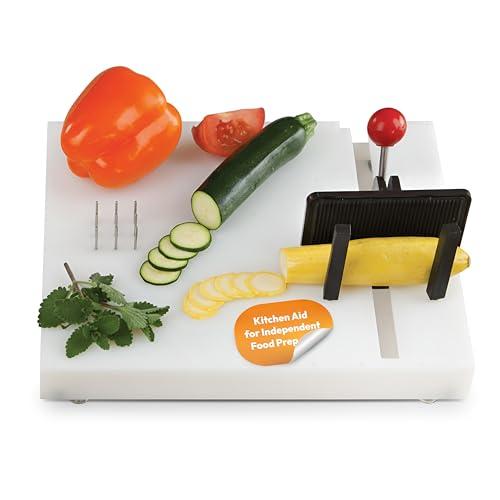
For most people the Etac Fix preparation board is the right answer: a board with adjustable jaws that clamp a bowl or a vegetable, a removable spiked plate, and feet that stop the whole thing sliding. If several tasks rather than one have become difficult, the Homecraft Kitchen Workstation adds a grater and slicer to the same idea.
Cooking with one usable hand fails at a very specific moment. Not the knife - most people manage a knife. It fails at the half-second where an onion rolls, a potato turns, a loaf slides away from the bread knife, and the hand that would normally steady it is in a sling, affected by a stroke, or simply has no grip left.
An adaptive board solves that by becoming the second hand. Stainless spikes hold the food; a clamp holds a bowl while it is stirred; a raised corner stops a slice of bread sliding while it is buttered; suction feet stop the board itself traveling across a wet counter. That is four distinct jobs, and boards differ in how many of them they do.
Four options are below plus the cheap fix that is sometimes all that is needed, ranked on what each one actually holds. We have not cooked on any of them; the details come from manufacturer and retailer specifications, attributed to whoever states them. Availability was checked before publishing.
Some links on this page go to Amazon. If you buy something, we may earn a small commission at no extra cost to you — it never changes which products we pick or the order they appear in. Full disclosure.
Quick picks
Ranked for how little strength, eyesight or patience they need — not for how much they cost.
| # | Product | Best for | Score | Price |
|---|---|---|---|---|
| 1 | Etac Fix preparation boardAdjustable jaws, a removable spiked plate and non-slip feet on one compact board - the most genuinely useful of these designs. | Most people, and the widest range of holding jobs | 9.0 | Check price on Amazon #ad Prices change daily, so we send you to check today's. How we earn |
| 2 | 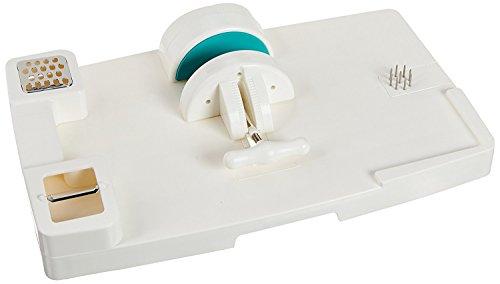 Homecraft Kitchen WorkstationThe most tools built into one board - spikes, a bowl clamp, a grater, a slicer and a corner that holds bread while you butter it. | A whole one-handed kitchen on one board | 8.6 | $109.76 · View on Amazon #ad Price as of November 28, 2026. How we earn |
| 3 | 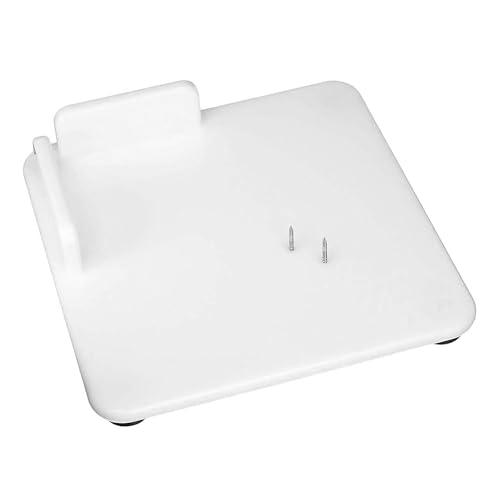 Sammons Preston Paring BoardTwo spikes, a corner guard and four suction feet on a plain high-density board - no clamp, no grater, and much less to go wrong. | The simple version, where only the food needs holding | 8.2 | $69.99 · View on Amazon #ad Price as of November 28, 2026. How we earn |
| 4 | 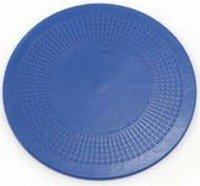 Dycem Non-Slip MatA tacky rubber mat under the board you already own. It will not hold the food, and for a surprising number of kitchens that is not the problem. | The budget pick, when the board slides but the food does not | 7.8 | $29.95 · View on Amazon #ad Price as of November 28, 2026. How we earn |
| 5 | 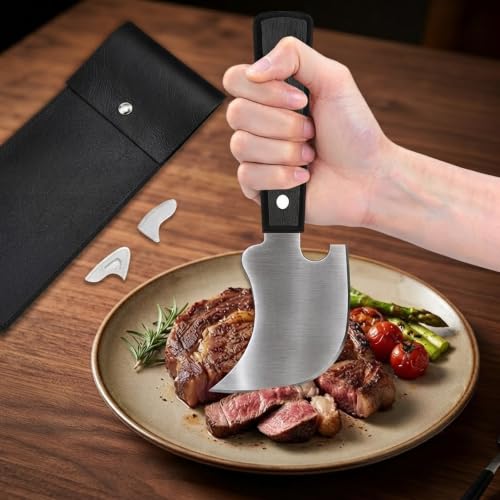 Rocker Knife (one-handed)A curved blade rocked through food with downward weight instead of a sawing stroke. A one-handed board without one is half a solution. | The other half of the job - the knife, not the board | 7.6 | $9.99 · View on Amazon$17.99(44% off) #ad Price as of November 28, 2026. How we earn |
Tap any row to jump to the full write-up. The price button goes to Amazon.
Pick by what’s hard
Most lists sort by price. That is not how this decision actually gets made, so here it is sorted by the thing that is getting in the way.
- One hand genuinely unavailable - stroke, amputation, a sling
- Etac Fix preparation board — you need jaws as well as spikes, because a bowl and a grater cannot be held by points. Buy the rocker knife at the same time.
- Both hands work but neither has any grip
- Dycem Non-Slip Mat — start here. Weak hands usually need the board to stop moving, not the food to be pinned, and that is a few dollars rather than a hundred.
- Buttering bread is the specific thing that fails
- Homecraft Kitchen Workstation — a raised L-shaped corner gives the slice two walls to push against. It is the one feature that restores this particular task.
- Hands shake
- Sammons Preston Paring Board — spikes hold the food still so the tremor only affects the knife hand. Fewer spikes are easier and safer to load than a bed of them.
- Textured, tiled or wooden countertops
- Dycem Non-Slip Mat — suction feet need a smooth, clean, non-porous surface. On anything else they release without warning, and matting is the reliable answer.
- Standing at the counter is tiring
- Sammons Preston Paring Board — a light board can be carried to a kitchen table and used sitting down. The big workstation boards are heavy enough to be a job in themselves.
How we picked
We don’t run a product lab. Every pick here is chosen by reading the things that actually tell you whether something works for weak hands, poor eyesight or shaky fingers: the manufacturer’s own specifications, the retailer listing, the measurements and weights, and what owners report in their reviews — especially the one-star ones. We read the complaints before the praise.
Prices change constantly, so we send you to Amazon to see today’s price rather than printing a number that goes stale. More about how we choose.
The picks in full
1. Best for most people, and the widest range of holding jobs
Etac Fix preparation board
Etac · 9.0/10 on our rubric
#ad Prices change daily, so we send you to check today's. How we earn
Adjustable jaws, a removable spiked plate and non-slip feet on one compact board - the most genuinely useful of these designs.
Etac describes the Fix as a stable preparation board giving added precision for cooking tasks, intended for people with weak hands or one-hand function, and usable for grating, cutting, whisking and peeling. That list is the reason it leads here: it is not just a cutting board with spikes in it, it is a holding device that happens to have a cutting surface.
The jaws are what separate it from the cheaper boards. They adjust to grip a bowl, a grater or a piece of food, which means a mixing bowl can be whisked one-handed and a block of cheese can be grated without the grater skating off. Most adaptive boards only have spikes, and spikes hold a potato but do nothing for a bowl.
The spiked plate is small and removable, and it can be turned spikes-down to give an ordinary flat surface. That matters more than it sounds for a shared kitchen: a board bristling with stainless points is not something you want a grandchild reaching for, and being able to flip it over turns it back into a normal board in a second.
Etac lists it at 315 mm long, 295 mm wide and 35 mm high, weighing 1300 g, with a polystyrene board, stainless steel metal parts and PC/ABS jaws, standing on four friction feet or enclosed suction feet, and machine washable. The reservations are the price - it is the most expensive board here and sold mainly through mobility and therapy suppliers rather than general retailers - and the size, which at roughly 12 by 12 inches is smaller than the big American chopping boards people are used to.
Good
- Adjustable jaws grip a bowl, a grater or the food itself
- Removable spiked plate that reverses to a flat surface
- Four friction feet or enclosed suction feet, per Etac
- Machine washable, per Etac
- Designed explicitly for one-hand function, not adapted from a standard board
Watch out for
- The most expensive board on this page
- 315 x 295 mm, so smaller than a typical household chopping board
- 1300 g, so it is not something to lift in and out of a cupboard daily
- Sold mainly through therapy and mobility suppliers, not general retailers
| Size | 315 x 295 x 35 mm, per Etac |
|---|---|
| Weight | 1300 g, per Etac |
| Materials | Polystyrene board, stainless steel parts, PC/ABS jaws |
| Holding | Adjustable jaws plus a removable reversible spiked plate |
| Feet | Four friction or enclosed suction feet |
| Cleaning | Machine washable |
How it scores
- What it can hold9.6
- Stays put on the counter9.0
- Easy to clean8.8
- Value for the money7.0
2. Best for a whole one-handed kitchen on one board
Homecraft Kitchen Workstation
Homecraft · 8.6/10 on our rubric
#ad Price as of November 28, 2026. How we earn
The most tools built into one board - spikes, a bowl clamp, a grater, a slicer and a corner that holds bread while you butter it.
If the Etac is the elegant answer, this is the comprehensive one. Performance Health lists a chopping board measuring 19-3/4 by 11-3/4 inches with suction cup feet that hold on wet countertops, removable stainless steel spikes, a removable clamp that holds a bowl with an edge that reverses from flat to contoured, a removable grater and slicer with a protective cover, and a raised L-shaped corner that holds a slice of bread while buttering or spreading.
The bread corner is the detail that wins people over, and it is the one most able-bodied reviewers skip past entirely. Buttering toast one-handed is close to impossible on a flat surface, because the bread travels away from the knife; a raised L gives it two walls to push against. It is a small feature that restores a specific daily thing.
The board is also much bigger than the Etac - nearly twenty inches long, which is a normal American chopping board rather than a compact one. For a household cooking proper meals rather than preparing a sandwich, that difference is real.
Two honest cautions. First, the page's own statements about latex conflict: it describes the product as BPA, phosphate and latex free, while the symbol definitions on the same page state that the product contains natural rubber latex which may cause allergic reactions. If latex matters in your house, ask the seller before ordering rather than trusting either line. Second, more removable parts means more things to wash, lose and put back - it is dishwasher safe, but a board with five detachable components asks more of the person tidying up than a board with two.
Good
- 19-3/4 x 11-3/4 in board, per Performance Health - a full-size work surface
- Removable stainless steel spikes plus a removable bowl clamp with a reversible edge
- Raised L-shaped corner for buttering bread one-handed
- Removable grater and slicer with a protective cover
- Suction cup feet rated by the seller for wet countertops; dishwasher safe
Watch out for
- The listing contradicts itself on latex - it says latex free and also carries a natural rubber latex warning
- Five detachable parts to wash, store and not lose
- Carries a California Proposition 65 warning
- Listed as a hygiene product, so returns and exchanges are not accepted
- Costs more than most households expect to pay for a chopping board
| Board size | 19-3/4 x 11-3/4 in, per Performance Health |
|---|---|
| Holding | Removable stainless spikes, removable bowl clamp, raised L corner |
| Extras | Removable grater and slicer with cover |
| Feet | Suction cups, rated for wet countertops |
| Cleaning | Dishwasher safe |
| Item | 081112259, per Performance Health |
How it scores
- What it can hold9.2
- Stays put on the counter8.6
- Easy to clean6.8
- Value for the money7.4
3. Best for the simple version, where only the food needs holding
Sammons Preston Paring Board
Sammons Preston · 8.2/10 on our rubric
#ad Price as of November 28, 2026. How we earn
Two spikes, a corner guard and four suction feet on a plain high-density board - no clamp, no grater, and much less to go wrong.
Not everybody needs a workstation. If the only thing that fails is holding a potato while peeling it, a simple spiked paring board does that job for a fraction of the money and takes up a fraction of the drawer.
Performance Health lists this one as a high density polyethylene board with four rubber suction feet, two aluminum spikes to hold food for peeling and slicing, and a corner guard to keep food such as bread or grapes from sliding off. It is described as dishwasher safe and designed to resist cracking and breaking, with the aluminum parts chosen to resist rust and corrosion.
Two spikes rather than a bed of them is a deliberate design rather than a cost saving: two points hold a potato or an apple perfectly well and are far less unpleasant to clean around and to wash up near. The corner guard does the same job as the Homecraft's L-shaped corner on a smaller scale.
The limitations are the ones you would expect, and they are worth being plain about. There is no clamp, so a mixing bowl still slides and a grater still needs holding. The spikes are aluminum rather than stainless, which is softer and will bend if somebody pushes a frozen item onto them. And the page carries the same contradictory latex statement as the Homecraft - described as latex-free while also displaying a natural rubber latex warning - so check with the seller if that matters.
Good
- High density polyethylene, dishwasher safe, designed to resist cracking
- Four rubber suction feet, per Performance Health
- Corner guard holds bread, grapes and other food that slides
- Far cheaper and far smaller than the full workstation boards
- Only two spikes, so it is easier to clean around and less alarming on a counter
Watch out for
- No clamp, so a bowl or grater still has to be held
- Aluminum spikes rather than stainless - softer, and they will bend under a frozen item
- The listing both claims latex-free and displays a natural rubber latex warning
- Listed as a hygiene product, so no returns or exchanges
| Material | High density polyethylene |
|---|---|
| Holding | Two aluminum spikes and a corner guard |
| Feet | Four rubber suction feet |
| Cleaning | Dishwasher safe |
| Clamp | None |
How it scores
- What it can hold6.8
- Stays put on the counter8.4
- Easy to clean9.2
- Value for the money8.6
4. Best for the budget pick, when the board slides but the food does not
Dycem Non-Slip Mat
Dycem · 7.8/10 on our rubric
#ad Price as of November 28, 2026. How we earn
A tacky rubber mat under the board you already own. It will not hold the food, and for a surprising number of kitchens that is not the problem.
This is the budget pick, and before spending anything on an adaptive board it is worth being honest about which half of the problem you actually have. A board that slides and food that rolls are two different failures, and only one of them needs a hundred-dollar purchase.
Dycem is a tacky rubber matting that grips both the counter and whatever sits on it, without suction cups and without adhesive. Put an ordinary chopping board on a piece of it and the board stops moving, which for somebody with weak hands but two working arms is frequently the whole fix. It costs a few dollars, it cuts to size with scissors, and it washes in warm water.
It is also the thing to buy alongside an adaptive board rather than instead of it, because suction feet are not reliable on every surface. Suction wants a smooth, non-porous, clean counter: on a textured laminate, an unsealed wood block, or a tiled surface with grout lines running through it, suction cups let go at exactly the wrong moment. Dycem works on all of those.
What it cannot do is hold food. A potato on a Dycem-backed board still rolls, bread still travels away from the knife, and a bowl still turns while it is stirred. If the second hand is genuinely unavailable rather than just weak, this is not enough and one of the spiked boards above is the purchase.
Good
- A few dollars, against a hundred or more for an adaptive board
- Works where suction cups fail - textured, tiled or wooden counters
- Cuts to size with scissors and washes in warm water
- Useful in a dozen other places: under a plate, a mixing bowl, a jar
- Nothing to assemble, store or lose
Watch out for
- Does not hold the food at all - only the board
- Loses grip when it gets greasy, and needs washing more often than people expect
- Thin mats wear out and need replacing
- Will not help a genuinely one-handed cook with peeling or buttering
| Type | Non-slip rubber matting |
|---|---|
| Holds | The board, not the food |
| Fitting | Cut to size with scissors |
| Cleaning | Warm water |
How it scores
- What it can hold3.0
- Stays put on the counter9.4
- Easy to clean8.0
- Value for the money9.8
5. Best for the other half of the job - the knife, not the board
Rocker Knife (one-handed)
Various · 7.6/10 on our rubric
#ad Price as of November 28, 2026. How we earn
A curved blade rocked through food with downward weight instead of a sawing stroke. A one-handed board without one is half a solution.
An adaptive board solves holding. It does not solve cutting, and the two usually fail together. An ordinary knife needs a back-and-forth sawing action driven from the wrist and shoulder, with the other hand holding the food steady and the fingers curled out of the way.
A rocker knife replaces that with a single rolling movement. The blade is curved, so it is placed on the food and rocked from heel to tip, letting body weight do the cutting instead of arm movement. One hand, one motion, no sawing - and crucially, no need for a second hand anywhere near the blade.
The pairing is what makes a one-handed kitchen work. Spikes hold the carrot, the rocker knife cuts it, and neither tool asks for the hand that is not available. Buying the board and keeping an ordinary chef's knife is the commonest mistake in this category, and it leaves the harder half of the task unchanged.
The honest cautions are about the blade itself. A rocker knife is still a sharp knife, and the rocking motion puts it closer to a resting forearm than a conventional cut does, so a board with a raised edge is worth having under it. Some versions are table knives for eating rather than prep knives for cooking, and the two are not interchangeable - read what you are buying.
Good
- Cuts with a rocking motion and body weight rather than a sawing stroke
- Needs no second hand on the food
- Pairs naturally with a spiked board - the two solve opposite halves of the task
- Widely sold and inexpensive compared with the boards
Watch out for
- Still a sharp knife, and the rocking motion brings it near a resting forearm
- Table-knife versions for eating are not the same as prep versions for cooking
- Does nothing about food that rolls - it needs a board that holds
- A curved blade is awkward for fine slicing
| Type | Curved one-handed cutting knife |
|---|---|
| Action | Rocked heel to tip under body weight |
| Hands needed | One |
| Pair with | A spiked or clamping board |
How it scores
- What it can hold1.0
- Stays put on the counter5.0
- Easy to clean8.8
- Value for the money9.0
How we ranked these
- What can it actually hold? Spikes hold solid food. A clamp holds a bowl or a grater. A raised corner holds bread. A board that only has spikes solves one of those three, and the listings rarely make that clear.
- Does it stay put? Suction feet work well on a smooth, clean, non-porous counter and poorly on anything else. A board that slides while a knife is being pushed through food is worse than no adaptive board at all.
- How hard is it to clean? This is the quiet reason adaptive boards get abandoned. Spikes, clamps and graters all trap food, and a person with one working hand is also washing up with one working hand.
- Is it worth the money? These boards cost several times what a chopping board costs, and for some households a few dollars of non-slip matting does the whole job. We say so rather than selling up.
Chopping boards are normally reviewed on material, knife-friendliness and whether they warp. None of that is why somebody searches for a one-handed board. We ranked on four things, and they are the four scores on each pick above.
What we did not rank on: knife edge retention, end grain versus edge grain, or how the board looks on a counter. Those matter on a cook's board and are irrelevant here.
Spikes, clamp or corner - what each one is for
Suction feet are not as reliable as the listings suggest
Every adaptive board is sold on its suction feet, and the feet are the part most likely to disappoint. Suction needs three things at once: a smooth surface, a non-porous surface, and a clean dry-ish one. Plenty of real kitchens supply none of the three.
Textured laminate defeats suction because the cups cannot seal against the pattern. Tiled counters defeat it because grout lines run under the cup. Unsealed wood and butcher block defeat it because the surface is porous and the vacuum bleeds away over a minute or two - which is worse than failing immediately, because the board holds while you set up and lets go while you are cutting.
Two practical answers. Test the board on your own counter before you rely on it, by pressing it down and then deliberately trying to shove it sideways with the heel of your hand. And keep a piece of non-slip matting to put underneath, which converts almost any surface into one the board will hold on.
Wiping the counter and the cups with a damp cloth before pressing the board down genuinely improves the seal. Dust is what breaks suction most often, and it is the easiest thing to fix.
The rest of the one-handed kitchen
A board is one station. Several other daily jobs assume two hands just as firmly, and they are worth solving at the same time rather than discovering one at a time over six months.
Opening jars is the big one, and the only type that genuinely works with one hand is an under-cabinet opener that grips the lid for you - our jar opener roundup has a one-handed section for exactly this reason. Opening cans one-handed needs a countertop electric unit that holds the can itself rather than a handheld model. Pouring from a full kettle needs a kettle tipper or a tipping kettle. Eating needs a plate guard or a scoop dish so food can be loaded onto a fork against a wall rather than chased around a flat plate.
None of those is expensive on its own. Taken together they are the difference between a kitchen somebody can still use and a kitchen somebody has quietly stopped going into, which is usually the real thing at stake.
What to check before you order
- Does it clamp, or only spike? A board with no clamp will not hold a bowl or a grater, and that is half of cooking.
- Can the spikes be removed or turned over? A permanently spiked board is harder to share and harder to wash around.
- What surface will it live on? Suction feet need smooth, clean, non-porous counters. On anything else, plan on non-slip matting underneath.
- How heavy is it? Anything over about two pounds is not getting carried to a table to be used sitting down.
- Dishwasher safe, and how many removable parts? Five detachable components is five things to wash one-handed.
- Return policy. Several of these are classed as hygiene products by medical suppliers and cannot be returned at all, so measure your counter first.
Questions people ask
▸What is a one-handed cutting board?
A chopping board with features that do the holding a second hand would normally do - stainless spikes that pin food in place, an adjustable clamp for a bowl or grater, a raised corner that stops bread sliding, and suction feet that keep the board itself still. The Etac Fix is the most capable of the ones sold in the US.
▸Do I need an adaptive board, or just a non-slip mat?
If the board slides but you can still steady food with your other hand, a few dollars of non-slip matting is the whole fix. If the second hand is genuinely unavailable - after a stroke, with an arm in a sling, or with no grip at all - you need spikes and ideally a clamp, and matting will not get you there.
▸How do you butter bread with one hand?
On a board with a raised corner or an L-shaped guard. The bread is pushed into the corner so it has two walls to brace against, and the knife works against those walls instead of chasing the slice around a flat surface. The Homecraft Kitchen Workstation and the Sammons Preston paring board both have one.
▸Are the spikes on these boards safe?
They are stainless or aluminum points about an inch long and they do need respect, especially in a kitchen a grandchild comes into. The better designs let you remove the spike plate or turn it spikes-down, which converts the board back to an ordinary surface in a second.
▸Can you put an adaptive cutting board in the dishwasher?
Most are listed as dishwasher safe, including the Homecraft workstation and the Sammons Preston paring board, and Etac lists the Fix as machine washable. The practical issue is not the dishwasher but the number of removable parts - a board with five detachable components is more washing up, not less.
▸What knife should I use with a one-handed cutting board?
A rocker knife. Its curved blade is rocked from heel to tip using body weight instead of a sawing action, so it needs only one hand and no second hand holding the food. Pairing a spiked board with an ordinary chef's knife leaves the harder half of the task unsolved.
Sources
Read next
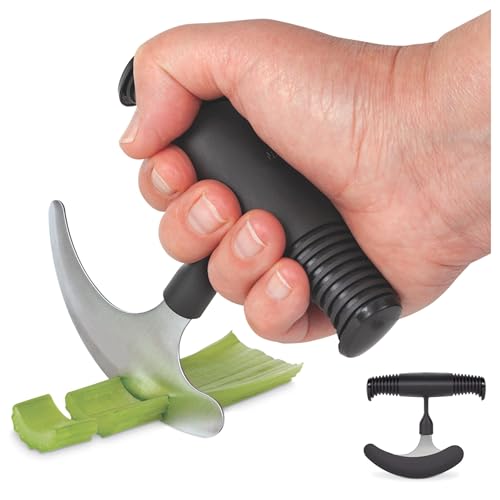
Best one-handed set
Adaptive utensils for one-handed eating
The four items that make one-handed eating workable, in the order to buy them.
Read the guide →
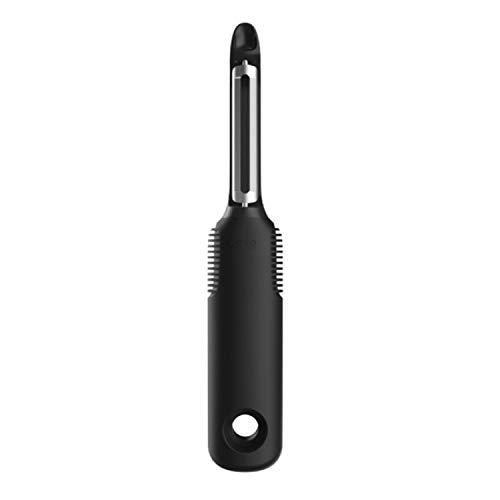
Best grip-friendly tools
Easy-grip kitchen tools for arthritic hands
The small tools that make cooking possible again, chosen for grip rather than brand.
Read the guide →
Guide
Setting up a kitchen for arthritic hands
The free rearranging first, then the handful of tools worth buying.
Read the guide →
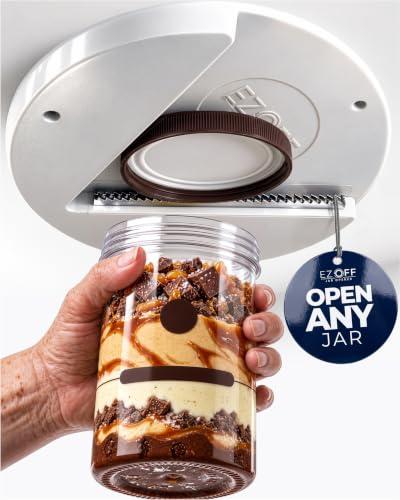
Best jar opener
Best jar openers for arthritis and weak hands
Jar openers grouped by grip strength, including one-handed and fully electric options.
Read the guide →
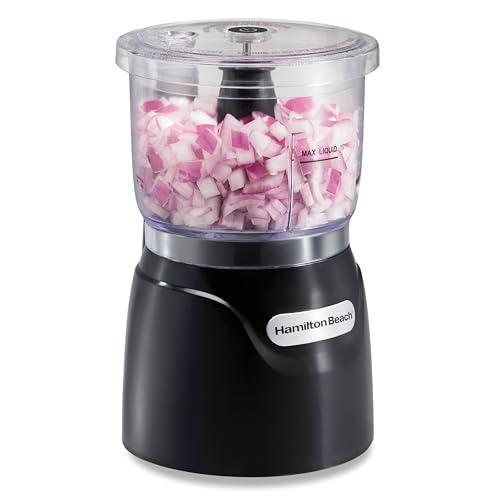
Best vegetable chopper
Best vegetable choppers for arthritis
Choppers ranked on hand force required, blade safety and how awkward each one is to wash.
Read the guide →
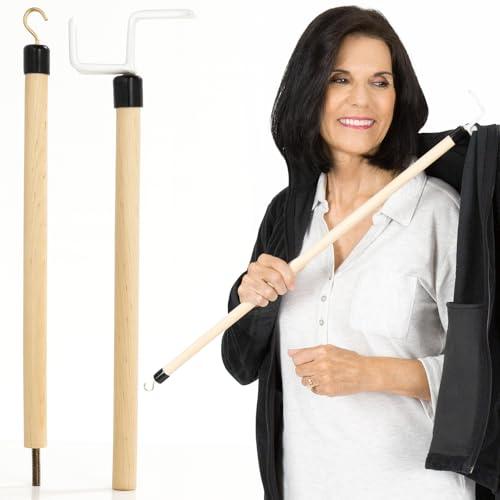
Best dressing aids
Best dressing aids
Dressing sticks, shoe horns, button hooks and no-tie laces compared by the movement each one removes - reaching, bending, pinching or pulling.
Read the guide →