Best dressing aids
Getting dressed is four separate problems wearing one name. Buy for the one that is actually stopping you, not for the kit that covers all four badly.
By Selena H. · Last checked November 12, 2026 · How we keep pages current
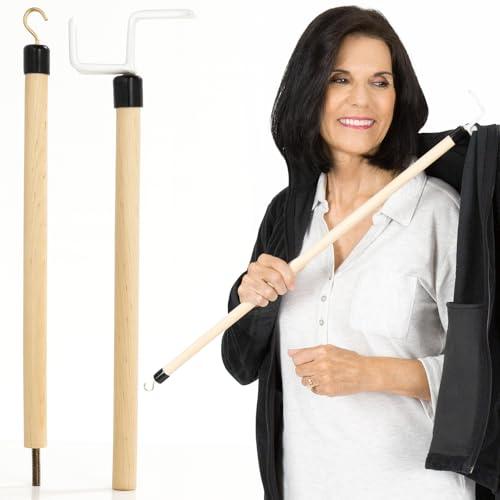
For most people the single most useful tool is a dressing stick, and the Vive Dressing Stick is the one to start with: a 27-inch birch stick with a hooked end that pushes and pulls clothing you can no longer reach. If more than one part of dressing has become hard, the Sammons Preston 4-Piece Home Care Kit is better value than buying the same four tools separately.
Getting dressed stops working for four different reasons, and they do not arrive together. You cannot bend far enough to reach your feet. You cannot pinch hard enough to work a button or a zipper tab. You cannot reach behind you to pull a sleeve or a waistband up. Or you have one working hand and every garment assumes two.
Each of those has a different tool, and buying the wrong one is the usual outcome. A long shoe horn is useless if the problem is buttons. A button hook does nothing for someone who cannot reach their shoes. The four-in-one kits sell well precisely because nobody knows which problem they have until they try, which is a reasonable argument for the kit and a bad argument for everything in it.
Five options are below, ranked by how much of the movement each one actually removes. We have not used any of them; what follows comes from manufacturer specifications, current retailer listings and what owners report, with every figure attributed to the source that states it. Availability was checked before publishing.
Some links on this page go to Amazon. If you buy something, we may earn a small commission at no extra cost to you — it never changes which products we pick or the order they appear in. Full disclosure.
Quick picks
Ranked for how little strength, eyesight or patience they need — not for how much they cost.
| # | Product | Best for | Score | Price |
|---|---|---|---|---|
| 1 | Vive Dressing StickA hooked stick that pushes and pulls clothing onto a body that can no longer reach it - the most useful single purchase here. | The widest range of jobs from one tool | 9.0 | $12.99 · View on Amazon #ad Price as of November 28, 2026. How we earn |
| 2 | 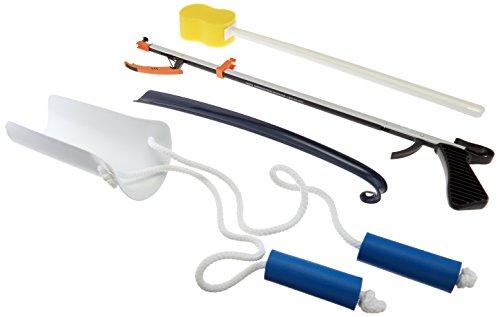 Sammons Preston Economy Hip Kit II (4-piece)Reacher, sock aid, long shoe horn and bath sponge in one box - the standard discharge kit after hip surgery, and the cheapest way to find out which tool you actually use. | A hip or knee replacement, and anyone unsure which tool they need | 8.8 | $40.00 · View on Amazon #ad Price as of November 28, 2026. How we earn |
| 3 | 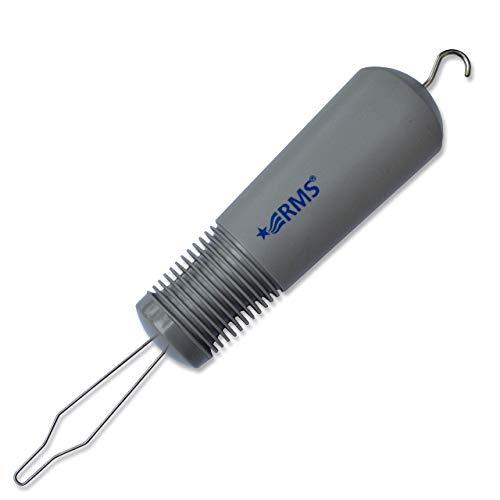 RMS Button Hook with Zipper PullA fat ribbed handle with a wire loop on one end and a zipper hook on the other - the answer when the fingers have stopped pinching. | Buttons and zipper tabs, with fingers that cannot pinch | 8.4 | $7.99 · View on Amazon$13.99(43% off) #ad Price as of November 28, 2026. How we earn |
| 4 | 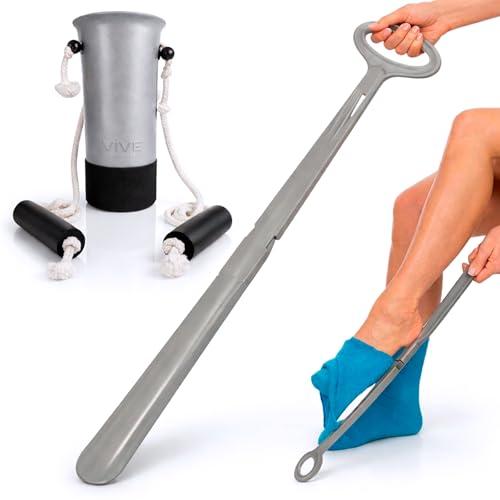 Vive Sock Aid Kit with Detachable Shoe HornA flexible sock cradle on long cords plus a 23-inch shoe horn that splits in two - the feet, covered in one purchase. | Socks and shoes, from a seated position | 8.2 | $19.99 · View on Amazon #ad Price as of November 28, 2026. How we earn |
| 5 | 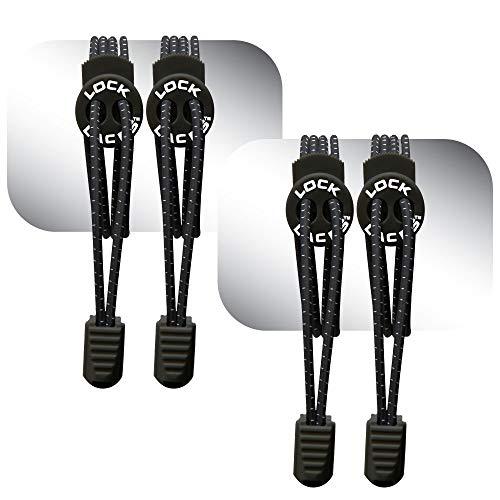 Lock Laces Original No-Tie ShoelacesElastic laces fitted once with a spring lock, after which every lace-up shoe behaves like a slip-on. The cheapest useful thing on this page. | The budget pick, and the one change that lasts forever | 8.0 | $14.99 · View on Amazon$19.98(25% off) #ad Price as of November 28, 2026. How we earn |
Tap any row to jump to the full write-up. The price button goes to Amazon.
Pick by what’s hard
Most lists sort by price. That is not how this decision actually gets made, so here it is sorted by the thing that is getting in the way.
- Cannot bend to reach the feet
- Vive Sock Aid Kit with Detachable Shoe Horn — socks and shoes are the only part of dressing that genuinely requires reaching the floor. Solve that end first and the rest usually still works.
- Fingers cannot pinch a button or a zipper tab
- RMS Button Hook with Zipper Pull — buy for handle diameter, not for the hook. A thin-handled button hook asks for the same pinch you cannot do.
- Only one working hand
- Vive Dressing Stick — a hooked stick is the one tool that genuinely works one-handed for upper-body clothing. Pair it with elastic laces so shoes stop needing two hands at all.
- Just had a hip replacement
- Sammons Preston Economy Hip Kit II (4-piece) — buy the kit before the surgery, not after. The 90-degree restriction starts the day you come home and a reacher ordered that week arrives too late.
- Tires out halfway through getting dressed
- Lock Laces Original No-Tie Shoelaces — remove steps rather than making them easier. Elastic laces, pull-on pants and front-fastening tops take minutes off the whole routine.
- Hands shake
- Sammons Preston Economy Hip Kit II (4-piece) — a tremor makes hooking and threading difficult, so favor tools with wide targets - a reacher jaw and a shoe horn - over a fine hook.
How we picked
We don’t run a product lab. Every pick here is chosen by reading the things that actually tell you whether something works for weak hands, poor eyesight or shaky fingers: the manufacturer’s own specifications, the retailer listing, the measurements and weights, and what owners report in their reviews — especially the one-star ones. We read the complaints before the praise.
Prices change constantly, so we send you to Amazon to see today’s price rather than printing a number that goes stale. More about how we choose.
The picks in full
1. Best for the widest range of jobs from one tool
Vive Dressing Stick
Vive Health · 9.0/10 on our rubric
#ad Price as of November 28, 2026. How we earn
A hooked stick that pushes and pulls clothing onto a body that can no longer reach it - the most useful single purchase here.
A dressing stick is the tool that does the most jobs, which is why it is the one to buy if you are only buying one. The hooked end catches a waistband and pulls it up a leg; the opposite end pushes a sleeve off a shoulder; the hook catches a bra strap behind the back, a sock heel, a shoe tongue and a coat collar. Nothing else on this page covers that much ground.
Vive lists this one as birch wood with a metal joint, a vinyl-coated metal S-hook at one end and a small metal zipper pull at the other, 27 inches long and about 3.4 ounces. Twenty-seven inches is the figure that matters: it is roughly the distance from a seated hand to the floor, which is the whole point of the tool.
The detail worth noticing is that it separates into two pieces, listed at 14.17 and 13.07 inches. That is not just a storage feature - it means the stick travels, and a dressing aid that lives in a suitcase is one that still works on the week away where the hotel chair is the wrong height and there is no rail to hold.
Two honest reservations. A hook on a stick requires a steady hand and a bit of aim; a pronounced tremor makes catching a waistband genuinely fiddly, and the first week is clumsy for everyone. And a stick is leverage, not strength - if the hands cannot grip the stick itself, this is the wrong starting point and a reacher with a trigger grip is the better one.
Good
- Covers more dressing jobs than any other single tool here
- 27 inches long, per Vive - enough to reach the floor from a seated position
- Separates into two pieces, so it fits in a case and travels
- Light at about 3.4 ounces, per Vive, so a weak arm can hold it out
- Listed by Vive as latex-free, which matters more in this category than people expect
Watch out for
- Needs a steady hand - catching a waistband with a hook is fiddly with a tremor
- Needs enough grip to hold the stick itself
- A learning curve of several days before it feels natural
- Does nothing for buttons, which need a different tool entirely
| Length | 27 in, per Vive |
|---|---|
| Splits into | 14.17 in and 13.07 in |
| Weight | About 3.4 oz, per Vive |
| Material | Birch wood with a metal joint |
| Ends | Vinyl-coated S-hook, metal zipper pull |
How it scores
- Jobs it covers9.4
- Removes bending9.0
- Works with a weak grip6.8
- Easy to learn6.6
2. Best for a hip or knee replacement, and anyone unsure which tool they need
Sammons Preston Economy Hip Kit II (4-piece)
Sammons Preston · 8.8/10 on our rubric
#ad Price as of November 28, 2026. How we earn
Reacher, sock aid, long shoe horn and bath sponge in one box - the standard discharge kit after hip surgery, and the cheapest way to find out which tool you actually use.
This is what occupational therapy departments send people home with after a hip replacement, and the contents are not arbitrary. Performance Health lists the kit as a reacher in a 26 or 32 inch length, a 22 inch long-handled sponge, a 24 inch metal shoe horn and a 30 inch sock aid - four tools that between them let somebody obey a 90-degree hip precaution without asking for help every morning.
Buy it for the surgery, but buy it for the uncertainty too. Nobody knows in advance which of these they will reach for. Plenty of households discover that the reacher becomes a permanent fixture by the bed and the sponge never leaves the drawer; plenty find the opposite. Four tools for less than the price of two bought separately is the right way to find out.
The 32 inch reacher is the version to choose where there is a choice. The extra six inches is the difference between picking a sock off the floor from a chair and leaning forward to do it, and leaning forward is exactly the movement the kit exists to prevent.
The honest reservation is the sock aid. Owner reports on these kits are consistently mixed on that one item: some people find the molded aid works first time, and others report it needs more dexterity than expected to get the sock loaded onto the cradle in the first place. If socks are the main problem rather than one of several, buy a sock aid chosen on its own merits rather than taking whichever one came in the box.
Good
- Four tools for roughly the price of two bought separately
- The standard set for hip and knee replacement recovery
- Reacher available in a 26 or 32 inch length, per Performance Health
- 24 inch metal shoe horn is sturdier than the plastic ones in cheaper kits
- Covers the uncertainty of not yet knowing which movement is the problem
Watch out for
- Owner reports are mixed on the sock aid - loading the sock takes more dexterity than expected for some
- Kit contents vary between sellers and between the brands making near-identical kits - read the list, not the picture
- No button hook or dressing stick in this four-piece version
- Bulky to store, and most households end up using two of the four
| Reacher | 26 in or 32 in |
|---|---|
| Shoe horn | 24 in metal |
| Sock aid | 30 in |
| Sponge | 22 in long handle |
| Typical use | Hip or knee replacement recovery |
How it scores
- Jobs it covers9.0
- Removes bending9.4
- Works with a weak grip7.0
- Easy to learn7.4
3. Best for buttons and zipper tabs, with fingers that cannot pinch
RMS Button Hook with Zipper Pull
RMS Royal Medical Solutions · 8.4/10 on our rubric
#ad Price as of November 28, 2026. How we earn
A fat ribbed handle with a wire loop on one end and a zipper hook on the other - the answer when the fingers have stopped pinching.
A shirt button is one of the hardest fine-motor tasks in a normal day, and almost nobody notices until it stops working. It needs a pinch grip on something small, slippery and under tension, usually against the chest where you cannot see it. Arthritic fingers, a stroke-affected hand and a bad tremor all fail at it long before anything larger becomes a problem.
A button hook turns that pinch into a pull. The wire loop goes through the buttonhole, hooks the button, and you pull it back through - a whole-hand movement instead of a fingertip one. The Norco version is the one to buy because of the handle: Performance Health lists it at 4-1/4 inches long and 1-1/2 inches in diameter, in a soft ribbed rubber-like material, on a tool 7.5 inches overall.
That diameter is the specification that matters. An inch and a half is roughly the handle size that lets a hand with very little grip hold something securely by closing around it rather than squeezing it, which is the same principle behind every fat-handled kitchen tool we recommend. A thin button hook costs less and defeats its own purpose.
One warning that belongs on the page rather than in the small print: Performance Health states this product contains natural rubber latex. A great many older adults have a latex sensitivity from years of medical contact, and this is a tool that is held in the hand every single morning. If latex is an issue, buy a hook with a wooden or hard plastic handle instead and accept the thinner grip.
Good
- Turns a fingertip pinch into a whole-hand pull
- Handle listed at 1-1/2 in diameter and 4-1/4 in long, per Performance Health
- Zipper hook on the opposite end, so one tool does both fastenings
- Works one-handed, which almost nothing else about buttoning does
- Soft ribbed grip rather than smooth plastic
Watch out for
- Performance Health states it contains natural rubber latex - a real problem for a latex-sensitive hand
- 7.5 inches overall, so it is not pocketable
- Very small shirt buttons still need a careful hand
- Does nothing for anything below the waist
| Overall length | 7.5 in (19 cm), per Performance Health |
|---|---|
| Handle | 4-1/4 in long, 1-1/2 in diameter |
| Handle material | Soft ribbed rubber-like; contains natural rubber latex |
| Ends | Button hook and zipper pull |
How it scores
- Jobs it covers5.5
- Removes bending2.0
- Works with a weak grip9.4
- Easy to learn8.6
4. Best for socks and shoes, from a seated position
Vive Sock Aid Kit with Detachable Shoe Horn
Vive Health · 8.2/10 on our rubric
#ad Price as of November 28, 2026. How we earn
A flexible sock cradle on long cords plus a 23-inch shoe horn that splits in two - the feet, covered in one purchase.
Feet are where dressing fails first, because they are the only part of getting dressed that requires bending to the floor. A hip that will not flex past ninety degrees, a back that will not bend, a belly in the way, a shoulder that will not reach - all four end at the same place, which is a sock held six inches from a foot that cannot come up to meet it.
Vive's kit covers the two jobs at that end. The sock aid is a flexible cradle that the sock is stretched over and then pulled on by cords, which Vive lists at 33 inches and adjustable by a button slider. The adjustability is worth more than it sounds: a cord set for a tall person is slack and useless for a short one, and most cheap sock aids have a fixed length.
The 23-inch shoe horn in the kit separates into two pieces with a pinch-style connector, and it carries a sock removal hook at the other end. Taking socks off at night is a problem people rarely think to buy for and almost always have, because it needs the same reach as putting them on with a tired body at the end of the day.
The reservation is the one every sock aid shares. Getting the sock onto the cradle in the first place needs two hands and a reasonable amount of finger strength, and that step is where people give up. If the hands are the limitation rather than the back, read our sock aid roundup, which ranks the different cradle types specifically on how hard they are to load.
Good
- Covers socks on, socks off and shoes in one purchase
- 33 inch cords with a button slider, per Vive - adjustable to the user's height
- 23 inch shoe horn that separates in two for storage and travel
- Sock removal hook on the shoe horn, which is the step most kits forget
- Keeps the user inside a 90-degree hip restriction
Watch out for
- Loading the sock onto the cradle needs two hands and decent finger strength
- Flexible cradles suit thin socks better than thick ones
- Compression stockings are a different problem and need a purpose-made donner
- The shoe horn is plastic rather than the stiffer metal in the Sammons kit
| Sock aid cord | 33 in, adjustable by button slider, per Vive |
|---|---|
| Shoe horn | 23 in, separates into two pieces |
| Extra | Sock removal hook |
| Hands needed | Two, to load the cradle |
How it scores
- Jobs it covers7.0
- Removes bending9.6
- Works with a weak grip6.0
- Easy to learn7.0
5. Best for the budget pick, and the one change that lasts forever
Lock Laces Original No-Tie Shoelaces
Lock Laces · 8.0/10 on our rubric
#ad Price as of November 28, 2026. How we earn
Elastic laces fitted once with a spring lock, after which every lace-up shoe behaves like a slip-on. The cheapest useful thing on this page.
This is the budget pick and in some houses it is the only purchase needed. Tying a bow is a two-handed fine-motor task performed bent over at the end of getting dressed, when the back already hurts and the hands are already tired. Removing it entirely costs about the same as a sandwich.
The set is listed as two 48-inch elastic laces, two lock devices and two cord clips - enough for one pair of shoes. They are threaded once, tightened to the fit the wearer likes, the spring lock is set and the excess trimmed. After that the shoe is pulled on and off like a loafer, and the elastic gives slightly as the foot swells through the day.
That last point is the reason to prefer elastic laces over simply buying slip-on shoes. A foot that swells in the afternoon needs a shoe that gives, and a true slip-on with a fixed opening either fits in the morning or fits in the evening. Elastic laces move with the foot while still holding the heel, which matters for anyone unsteady on their feet.
Two honest limits. Fitting them is a fiddly ten minutes that somebody with good hands should do, which is fine when family is around and a problem when nobody is. And a locked elastic lace holds the foot less firmly than a tied bow, so for somebody whose balance depends on a shoe that grips the heel, this is a conversation to have with a physical therapist rather than a straightforward win.
Good
- Cheapest item on this page by a wide margin
- Two 48 in elastic laces, two locks and two cord clips per pack, per Lock Laces
- Removes tying permanently rather than making it easier once
- Elastic gives as the foot swells during the day
- Works with the shoes already in the closet
Watch out for
- Fitting them is fiddly and is a job for somebody with good hands
- Holds the heel less firmly than a tied bow - worth checking if balance is poor
- One pack does one pair of shoes
- Not a fix for the bending; the foot still has to be reached
| In the pack | 2 x 48 in elastic laces, 2 lock devices, 2 cord clips |
|---|---|
| Covers | One pair of shoes |
| Fitting | One-time, needs a dexterous pair of hands |
| After fitting | Shoes behave as slip-ons |
How it scores
- Jobs it covers3.5
- Removes bending5.0
- Works with a weak grip9.2
- Easy to learn9.6
How we ranked these
- How many dressing jobs does it cover? A tool that solves one step is worth buying only if that step is your step. A dressing stick covers five or six, which is why it leads the list for anyone who is not sure.
- How much bending does it remove? This is the single most valuable thing an aid can do, because reaching the floor is the movement that a hip precaution, a stiff back and a replaced knee all block at once.
- Does it work with a weak grip? Several of these tools quietly assume a hand that can hold, pinch or thread. Where a tool fails that test, it is named rather than glossed over.
- How easy is it to learn? An aid that takes two weeks of frustration to master is an aid that ends up in a drawer. The ones people stick with are the ones that work acceptably on day one.
Dressing aids are almost always reviewed by listing what is in the box. That tells you nothing about whether the thing will work for a particular pair of hands and a particular back, so we ranked on four questions instead, and they are the four scores on each pick above.
What we did not rank on: how many pieces come in the box, or how the set photographs. The four-piece kits all look similar in a listing and differ in the only thing that matters, which is whether the sock aid is loadable by the person who has to load it.
Change the clothes before you buy the tools
This costs nothing and it is more effective than anything on this page. A great deal of what gets diagnosed as a dressing problem is a fastening problem, and fastenings are a choice.
Pull-on pants with an elastic waist remove the button, the zipper and the belt in one go. A polo shirt or a front-opening cardigan removes the over-the-head reach that a stiff shoulder cannot do. Magnetic closures now exist on ordinary-looking shirts from several adaptive clothing brands and they replace a row of buttons with a press. Bras that fasten at the front remove the hardest reach in the whole routine.
None of this is giving up. Somebody who dresses themselves in eight minutes in pull-on pants is more independent than somebody who dresses themselves in forty with a button hook, and considerably more independent than somebody who has started waiting for help. Buy the aids for what the wardrobe change cannot solve.
A practical sequence: swap the fastenings first, time the routine for a week, and then buy an aid for whichever step is still the slow one. That is usually socks and shoes, which is why those tools sell most.
Which tool for which problem
The hip replacement checklist
- A reacher, ideally the 32 inch version, kept beside the chair and beside the bed rather than carried around.
- A sock aid, tried once before the surgery so the technique is already known.
- A long shoe horn, metal rather than plastic, so it does not flex when weight goes onto it.
- A dressing stick for pants and underwear, which is the step people most often need help with and most hate needing help with.
- Slip-on or elastic-laced shoes with a firm heel, already fitted and already worn in.
- A long-handled sponge, because washing below the knee has the same restriction as dressing below the knee.
Most people who buy dressing aids buy them for a hip or knee replacement, usually about a week too late. Surgical teams generally ask patients to avoid bending the hip past ninety degrees, crossing the legs and twisting for several weeks, and those three restrictions make dressing the hardest part of the first month at home.
Buy the kit before the operation and open it before you go in. The morning you come home is not when anybody wants to learn how a sock aid works, and it is certainly not when you want to discover that the one in the box is the one you cannot load.
Your surgical team's own instructions always outrank a shopping list. Ask them which restrictions apply to your specific operation, because an anterior approach and a posterior approach do not carry the same ones.
What to check before you order
- Handle diameter on anything that gets gripped. An inch and a quarter to an inch and a half is the range that works for a hand with very little strength; thin handles defeat the purpose.
- Length against the person, not against the listing. Measure from the seated hand to the floor and buy a stick and reacher longer than that figure.
- Latex. Several dressing aids use natural rubber latex in their grips, and that is a tool held every morning - check the listing if there is a latex allergy in the house.
- Whether a shoe horn is metal or plastic. Plastic flexes under body weight, which is exactly when a shoe horn is doing its job.
- Whether the set actually contains what the photo shows. Near-identical four-piece kits from different brands differ on shoe horn length and sock aid type.
- Whether it comes apart. A dressing aid that fits in a bag is one that still works away from home, and holidays are when routines break.
Questions people ask
▸What is the most useful dressing aid?
A dressing stick, if you are only buying one - its hooked end handles pants, sleeves, bra straps, socks and shoe tongues, which no other single tool does. If several parts of dressing have become difficult, a four-piece kit with a reacher, sock aid, long shoe horn and sponge is better value than buying the same tools one at a time.
▸What dressing aids do you need after a hip replacement?
A reacher, a sock aid, a long-handled shoe horn, a dressing stick and a long-handled sponge - the standard set, because all five let you dress and wash without bending the hip past ninety degrees. Buy them before the surgery and try them once, rather than learning on the day you come home.
▸How do you button a shirt with one hand?
With a button hook. The wire loop goes through the buttonhole, catches the button and pulls it back through, which turns a two-handed pinch into a one-handed pull. Choose one with a handle at least an inch and a quarter across, because the thin ones ask for the grip you are trying to avoid.
▸Do dressing aids work for arthritis?
Yes, but choose for handle thickness rather than for the tool. Arthritis is a grip and pinch problem, so a fat-handled button hook, a zipper pull and elastic laces help most, while long-handled tools help only if reach is also an issue. Changing fastenings in the wardrobe usually helps more than either.
▸Are no-tie elastic laces safe for older adults?
For most people yes, and they remove a bending, two-handed task entirely. The caveat is that a locked elastic lace holds the heel less firmly than a tied bow, so if balance is already poor it is worth asking a physical therapist before switching the everyday shoes.
▸Is a dressing stick or a reacher better?
They do different jobs. A reacher has a jaw that grips and is for picking things up off the floor. A dressing stick has a hook that pushes and pulls and is for moving clothing on and off a body. Most people who need one eventually want both, which is why the kits include a reacher and the stick is sold separately.
Sources
Read next
Best dressing aid
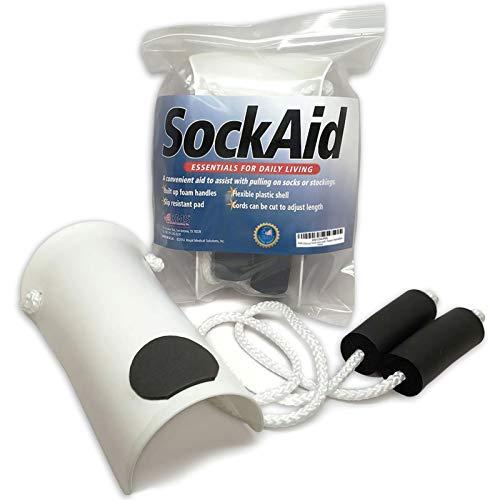
Best sock aids for seniors
Rigid and flexible sock aids, including the type that handles compression stockings.
Read the guide →
Best reacher
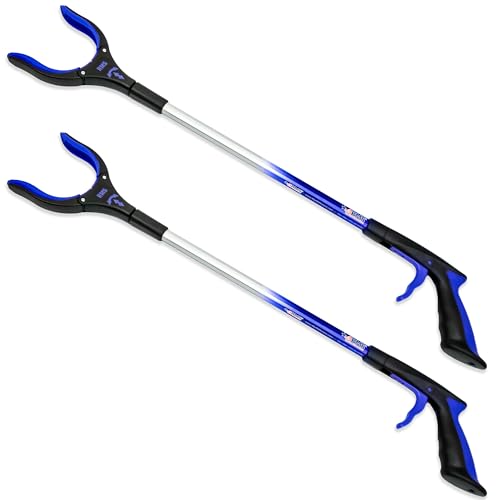
Best reacher grabbers for elderly adults
Reachers compared on grip strength required, jaw type and the right length for the job.
Read the guide →
Best for swollen feet
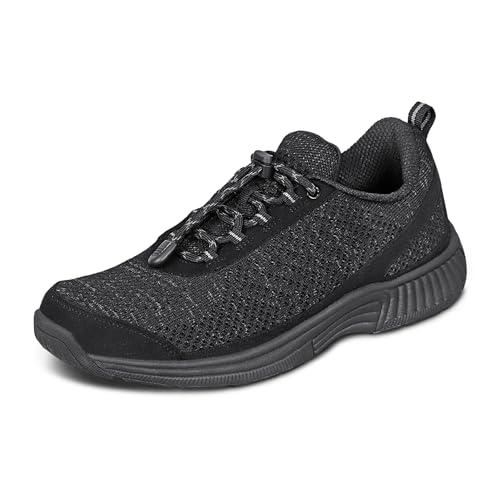
Best shoes for seniors with swollen feet
Shoes ranked on how far they adjust, how deep they are, and whether you can put them on without bending.
Read the guide →
Guide
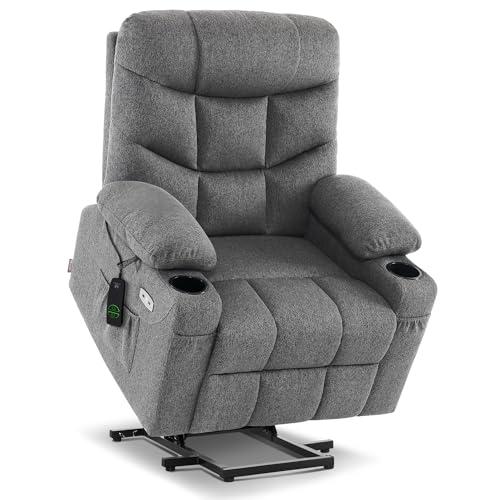
Getting up from a chair safely
The method, the chair features that help, and the equipment worth buying if it is still hard.
Read the guide →
Easiest compression socks
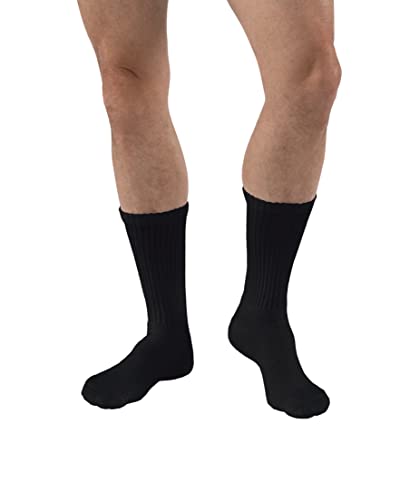
The easiest compression socks to put on
Compression socks and donning aids ranked by how much grip, bend and reach each one actually demands.
Read the guide →
Best one-handed board
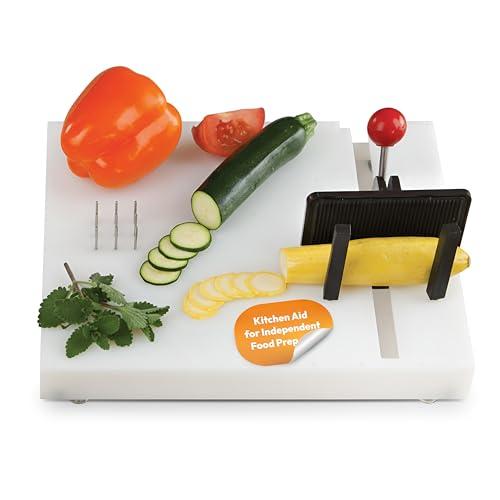
Best one-handed cutting boards
Adaptive boards with spikes, clamps and suction feet compared on what they actually hold - plus the cheapest fix if the board only slides.
Read the guide →