Best reading lamps for low vision
An older eye needs several times the light a young one does. Most households try a stronger pair of glasses first, when the cheaper fix was the lamp.
By Selena H. · Last checked November 22, 2026 · How we keep pages current
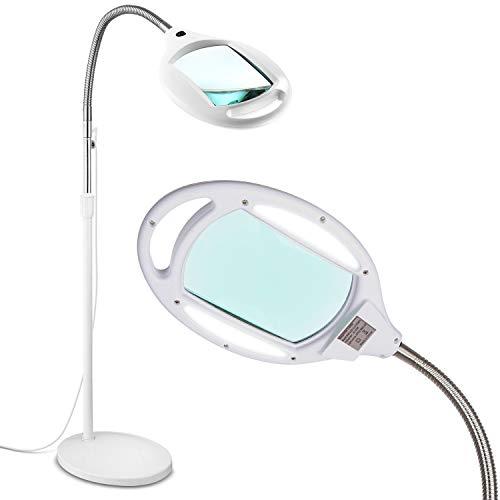
Buy the Brightech LightView Pro. It is a floor lamp with a genuine diopter glass magnifying lens built into the head, so the light and the magnification arrive at the page together from a 24-inch gooseneck - which is the arrangement that works, because holding a hand magnifier under a dim lamp means holding two things and solving neither problem. The budget pick is the Wio-Mio Floor Lamp at around twenty-seven dollars, which gives 1000 lumens with stepless dimming, a color temperature you can change and a magnetic remote that works from across the room.
Lighting is the cheapest thing you can do about failing eyesight and almost nobody does it first. A sixty-year-old retina needs substantially more light than a twenty-year-old's to read the same page, and that gap keeps widening - so the most common reason a newspaper has become unreadable in a particular armchair is the lamp beside it rather than the eyes above it. New glasses cost several hundred dollars. A lamp costs thirty.
What to look for is not wattage. It is three things: how much light actually lands on the page, which depends as much on how close the head gets as on the lumen figure; color accuracy, measured as CRI, because low-contrast gray print on off-white paper needs faithful light to separate; and glare, which is light arriving in the eye rather than on the page and which makes reading worse rather than better.
Prices below come from the live Amazon listing for each lamp and carry the date they were checked. We have not used these ourselves; the descriptions come from the manufacturers published specifications and what owners report. If reading has stopped working altogether rather than merely become harder, no lamp will fix it - our roundup of electronic magnifiers for macular degeneration covers what does.
Some links on this page go to Amazon. If you buy something, we may earn a small commission at no extra cost to you — it never changes which products we pick or the order they appear in. Full disclosure.
What to check before you buy
- Can the head get within a foot or two of the page? Light falls off fast with distance - a close 600-lumen head beats a distant 2000-lumen one
- CRI 90 or above. Faithful color is what separates gray print from off-white paper
- Adjustable color temperature. Daylight white around 5000K to 6000K for reading, warmer in the evening
- Dimmable, ideally stepless. Too much light causes glare, which is its own problem
- A findable switch. A big touch panel or a remote beats a tiny inline rocker on a cord behind the chair
- A gooseneck or a jointed arm, so the light can be aimed at the page rather than at the room
- A heavy base, because a floor lamp beside an armchair gets knocked
Aim the light at the page from the side, slightly behind the shoulder. Light coming from in front of the reader bounces off the paper into the eyes, which is glare.
Quick picks
Ranked for how little strength, eyesight or patience they need — not for how much they cost.
| # | Product | Best for | Score | Price |
|---|---|---|---|---|
| 1 | Brightech LightView Pro Magnifying Floor LampThe top pick: a daylight-bright floor lamp with a 6.5 by 4 inch real glass magnifying lens on a 24-inch gooseneck, so both hands stay free. | Light and magnification arriving at the page together | 9.1 | $114.99 · View on Amazon #ad Price as of November 28, 2026. How we earn |
| 2 | 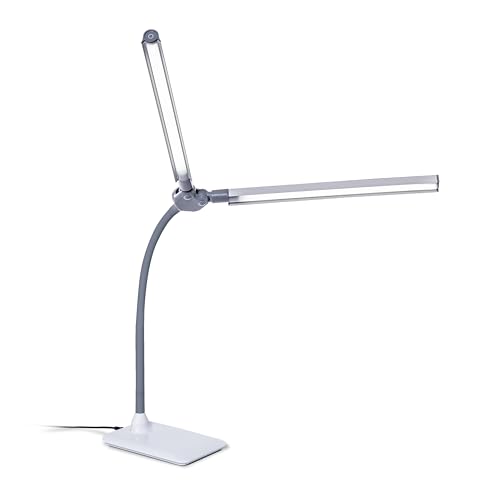 Daylight DuoPro Desk LampThe specialist pick: 56 daylight LEDs at 6000K and 95-plus CRI across a double shade, so the work is lit from two directions and casts no shadow. | Close work with no shadows - sewing, crosswords, jigsaws | 8.9 | $64.99 · View on Amazon$81.99(21% off) #ad Price as of November 28, 2026. How we earn |
| 3 | 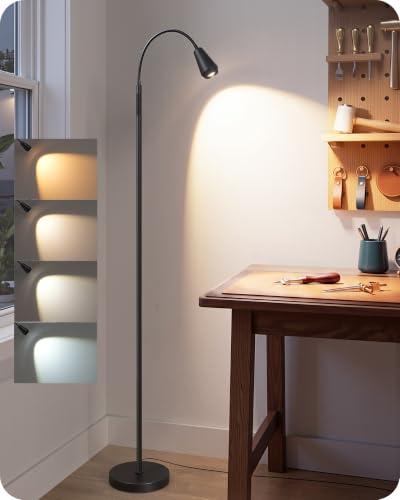 EDISHINE LED Reading Floor Lamp with Zoomable SpotlightA floor lamp with an optical lens that slides from a wide pool to a tight beam, CRI 90-plus, with a remote for somebody already in the chair. | A beam you can tighten onto the page, controlled by remote | 8.8 | $47.49 · View on Amazon$79.99(41% off) #ad Price as of November 28, 2026. How we earn |
| 4 | 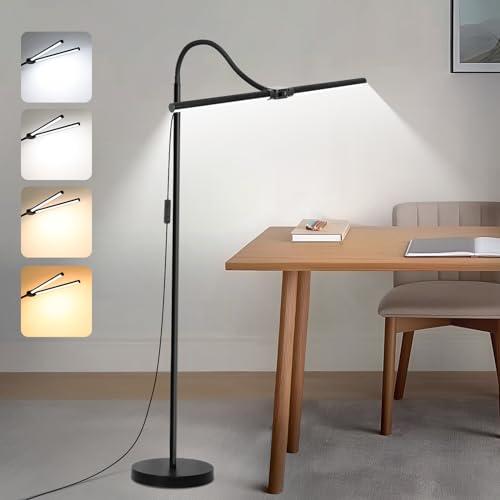 Double-Head LED Floor Lamp (18W, 2000 lumens)Two heads that spread 180 degrees apart and 2000 lumens between them - the lamp to buy when the whole corner of the room is too dark. | The most raw light for the money, across two heads | 8.3 | $32.99 · View on Amazon$38.99(15% off) #ad Price as of November 28, 2026. How we earn |
| 5 | 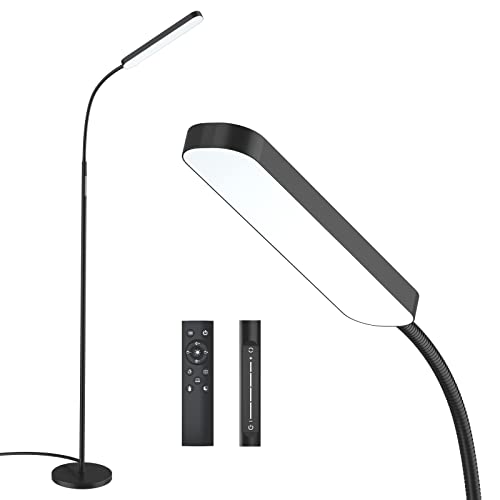 Wio-Mio LED Floor Lamp with RemoteThe budget pick: 1000 lumens, stepless dimming, 3000K to 6000K and a magnetic remote that works from across the room, for under thirty dollars. | The cheapest lamp here with a remote and stepless dimming | 8.2 | $27.06 · View on Amazon$37.99(29% off) #ad Price as of November 28, 2026. How we earn |
Tap any row to jump to the full write-up. The price button goes to Amazon.
Pick by what’s hard
Most lists sort by price. That is not how this decision actually gets made, so here it is sorted by the thing that is getting in the way.
- Print is too small even with enough light on it
- Brightech LightView Pro Magnifying Floor Lamp — buy the lamp with the lens in it. A hand magnifier plus a lamp needs two hands and still leaves a shadow; a magnifying lamp needs none and the page stays lit.
- Own hands cast a shadow over the work
- Daylight DuoPro Desk Lamp — a double-shade lamp lights from two directions, so the shadow from one source is filled by the other. This is the fix for threading a needle or working a jigsaw.
- Cannot get up to turn the light on and off
- Wio-Mio LED Floor Lamp with Remote — buy a lamp with a remote and keep the remote on the side table. It sounds minor and it is the difference between a lamp that gets used in the evening and one that does not.
- Light spills everywhere except onto the page
- EDISHINE LED Reading Floor Lamp with Zoomable Spotlight — a lamp with a focusable optical lens puts the light where you point it. More lumens flooding a room is not the same as more light on the words.
- The whole corner of the room is dark
- Double-Head LED Floor Lamp (18W, 2000 lumens) — two heads and 2000 lumens for thirty dollars is the most light per dollar here. Add a smaller close-up lamp beside the chair for actual reading.
How we picked
We don’t run a product lab. Every pick here is chosen by reading the things that actually tell you whether something works for weak hands, poor eyesight or shaky fingers: the manufacturer’s own specifications, the retailer listing, the measurements and weights, and what owners report in their reviews — especially the one-star ones. We read the complaints before the praise.
Prices change constantly, so we send you to Amazon to see today’s price rather than printing a number that goes stale. More about how we choose.
The picks in full
1. Best for light and magnification arriving at the page together
Brightech LightView Pro Magnifying Floor Lamp
Brightech · 9.1/10 on our rubric
#ad Price as of November 28, 2026. How we earn
The top pick: a daylight-bright floor lamp with a 6.5 by 4 inch real glass magnifying lens on a 24-inch gooseneck, so both hands stay free.
This is the lamp that solves the actual problem rather than half of it. Somebody struggling with small print needs more light and more size, and the usual answer - a hand magnifier plus whatever lamp is in the room - requires one hand holding the glass, one hand holding the paper, and no hand left for anything else. Brightech puts the lens in the lamp head, so the magnified, brightly lit area simply sits over the page and both hands are free.
The lens is genuine diopter glass rather than molded acrylic, which matters because acrylic lenses scratch, yellow and distort toward the edges. At 6.5 by 4 inches it covers a full column of newspaper rather than a word at a time, and the flexible 24-inch gooseneck means the whole assembly can be positioned over a book on a lap, a crossword on a side table or a pill bottle being checked.
Brightech describes it as full spectrum daylight bright and notes that customers with macular degeneration and aging eyes report using it - which is a statement about their reviews rather than a clinical claim, and should be read that way. The honest reservations: it is the most expensive lamp here, it is a substantial object beside a chair, and a magnifying lens is only useful where there is still usable central vision for it to magnify into.
Good
- Real diopter glass lens, 6.5 by 4 inches - a column at a time, not a word
- Light and magnification from one object, so both hands stay free
- 24-inch flexible gooseneck reaches a lap, a table or a shelf
- Daylight-bright full spectrum LED
Watch out for
- The most expensive lamp on this page
- A magnifier only helps where there is usable central vision to magnify into
| Type | Floor lamp with magnifier |
|---|---|
| Lens | 6.5 x 4 inch diopter glass |
| Arm | 24 inch flexible gooseneck |
| Light | Full spectrum daylight LED |
How it scores
- Light at the page9.2
- Color accuracy8.8
- Glare control8.6
- Switch you can find8.4
2. Best for close work with no shadows - sewing, crosswords, jigsaws
Daylight DuoPro Desk Lamp
Daylight · 8.9/10 on our rubric
#ad Price as of November 28, 2026. How we earn
The specialist pick: 56 daylight LEDs at 6000K and 95-plus CRI across a double shade, so the work is lit from two directions and casts no shadow.
Daylight is a company that makes lamps for people who do fine work - quilters, needleworkers, model makers - and the specification reflects it. Ninety-five-plus CRI at 6000K is the most faithful light on this page by a clear margin, and faithful light is exactly what you need to tell navy thread from black, or to read gray small print on cream paper.
The double shade is the clever part and it is not marketing. Two light sources side by side mean the shadow cast by a hand, a needle or a crochet hook from one is filled in by the other, so there is no dark spot over the thing being worked on. Anybody who has tried to thread a needle under a single bright lamp and found their own fingers in the way will understand immediately why that matters.
Four brightness levels on a touch dimmer, a pivoting head and a soft flexible arm, and it is light enough to be carried between a sewing table and an armchair. Two reservations: it is a desk lamp, so it needs a table beside the chair rather than standing on the floor, and 6000K is a cool clinical white that some people dislike for evening reading - there is no warm option on this one.
Good
- 95-plus CRI at 6000K - the most faithful light here
- Double shade fills in the shadow cast by your own hands
- Four brightness levels on a touch dimmer
- Light enough to carry between rooms
Watch out for
- A desk lamp - it needs a table, not a floor
- 6000K only; no warm setting for evening reading
| Type | Double-shade LED desk lamp |
|---|---|
| Color | 6000K, 95+ CRI |
| Brightness | 4 levels, touch dimmer |
| Best for | Sewing, crafts, crosswords, jigsaws |
How it scores
- Light at the page9.0
- Color accuracy9.8
- Glare control9.2
- Switch you can find8.2
3. Best for a beam you can tighten onto the page, controlled by remote
EDISHINE LED Reading Floor Lamp with Zoomable Spotlight
EDISHINE · 8.8/10 on our rubric
#ad Price as of November 28, 2026. How we earn
A floor lamp with an optical lens that slides from a wide pool to a tight beam, CRI 90-plus, with a remote for somebody already in the chair.
The feature to buy this for is the sliding beam. The head has an optical lens that moves between wide-area and focused light, so the same lamp can light a whole lap for a magazine or concentrate onto a half-page of small print - and because the lens shapes the beam rather than just brightening it, the light stays on the page instead of spilling into the room and the eyes.
CRI 90-plus at 600 lumens sounds modest next to the 2000-lumen lamps, and this is where the arithmetic of lighting is counterintuitive: a focused 600-lumen beam delivered a foot from the page puts far more usable light on the words than an unfocused 2000-lumen flood from four feet away. Color temperature is steplessly adjustable from 2700K to 6000K, so it can be daylight-white for the newspaper in the morning and warm for a novel at night.
The remote is the accessibility feature that goes unremarked. Somebody settled in an armchair with a blanket and a book should not have to get up to change a light, and a remote that lives on the side table is worth more in practice than a touch panel on the lamp pole. The reservation is the usual one for a value floor lamp: the gooseneck holds its position well when new, and will want occasional re-tightening after a year of being bent about.
Good
- Sliding optical lens - wide pool or tight beam from one lamp
- CRI 90-plus, stepless 2700K to 6000K
- Remote as well as touch control, for somebody already seated
- Reduced-glare optical lens rather than a bare LED strip
Watch out for
- 600 lumens - it relies on being close to the page
- Gooseneck may need re-tightening after a year of adjustment
| Type | Gooseneck floor lamp, zoomable spotlight |
|---|---|
| Output | 600 lumens, CRI 90+ |
| Color | 2700K to 6000K, stepless |
| Control | Touch and remote |
How it scores
- Light at the page8.8
- Color accuracy9.0
- Glare control9.4
- Switch you can find9.4
4. Best for the most raw light for the money, across two heads
Double-Head LED Floor Lamp (18W, 2000 lumens)
Seaside Village · 8.3/10 on our rubric
#ad Price as of November 28, 2026. How we earn
Two heads that spread 180 degrees apart and 2000 lumens between them - the lamp to buy when the whole corner of the room is too dark.
This is the brightest lamp on the page and the one to choose when the problem is not a single page but a whole dim corner. Two heads on a shared pole open out to 180 degrees, so one can be aimed at a book and the other at the side table, or both spread to light a sofa where two people read.
Eighteen watts producing a stated 2000 lumens across 160 LEDs is a lot of light for thirty-odd dollars, and five brightness levels plus selectable color temperatures mean it can be turned down to something comfortable in the evening. The goosenecks are 360-degree adjustable, so each head can be aimed independently.
Two honest reservations. The control is an inline switch on the cord rather than a remote or a large touch panel, which is the weakest point here for somebody with stiff fingers or poor eyesight - an inline rocker has to be found by feel behind a chair. And no CRI figure is published, which for low-vision reading is a real gap: this is a lamp that wins on quantity of light rather than on quality of it. For a dark room it is still the most light per dollar available.
Good
- 2000 lumens stated - the most raw light here
- Two independently aimed heads, opening to 180 degrees
- Five brightness levels and selectable color temperatures
- Around thirty dollars
Watch out for
- Inline cord switch rather than a remote or a large touch panel
- No published CRI figure - quantity of light rather than quality
| Type | Double-head gooseneck floor lamp |
|---|---|
| Output | 18W, 2000 lumens stated |
| Brightness | 5 levels, 5 percent to 100 percent |
| Control | Inline cord switch |
How it scores
- Light at the page9.4
- Color accuracy7.4
- Glare control7.6
- Switch you can find6.4
5. Best for the cheapest lamp here with a remote and stepless dimming
Wio-Mio LED Floor Lamp with Remote
Wio-Mio · 8.2/10 on our rubric
#ad Price as of November 28, 2026. How we earn
The budget pick: 1000 lumens, stepless dimming, 3000K to 6000K and a magnetic remote that works from across the room, for under thirty dollars.
At around twenty-seven dollars this is the cheapest pick here and it does not skip the feature that matters most for this audience: the remote. It is magnetic, so it sticks to the lamp pole rather than disappearing down the side of the chair, and it works from up to about fifty feet - which means a light can be turned on from the doorway of a dark room rather than crossed to find.
Fifteen watts and a stated 1000 lumens is enough for reading when the head is brought in close, and the color temperature runs from a warm 3000K to a daylight 6000K with stepless dimming in between, so the same lamp serves a bright morning newspaper and a soft evening. Six preset scenes and a one-hour timer round it out; the timer is genuinely useful for anybody who reads themselves to sleep.
The reservations are build and data. The gooseneck and pole are lighter than the pricier lamps, so the base is the thing to check on arrival - a light floor lamp beside an armchair will eventually get knocked. And no CRI figure is published. For a second lamp, a bedroom, or a household trying lighting for the first time before spending more, it is the obvious starting point.
Good
- Around twenty-seven dollars with a remote included
- Magnetic remote sticks to the pole instead of being lost
- Stepless dimming and 3000K to 6000K color
- One-hour timer for reading in bed
Watch out for
- Lighter build than the pricier lamps - check the base is stable
- No published CRI figure
| Type | Gooseneck floor lamp |
|---|---|
| Output | 15W, 1000 lumens stated |
| Color | 3000K to 6000K, stepless dimming |
| Control | Magnetic remote and touch panel |
How it scores
- Light at the page8.2
- Color accuracy7.4
- Glare control8.0
- Switch you can find9.6
Why distance beats wattage
Light obeys an inverse square law, which in plain terms means doubling the distance from the lamp head to the page cuts the light arriving there to a quarter. That single fact explains why a cheap lamp positioned a foot from a book outperforms an expensive one standing four feet away behind a chair, and why the lumen number on the box tells you much less than people assume.
The practical consequence is that the adjustable arm is a more important feature than the brightness rating. Buy a lamp with a gooseneck or a jointed arm that genuinely reaches over a lap or a side table, and then move it close. A reading lamp that lives three feet away because the arm will not bend further is a room light with ambitions.
The second consequence is about glare. Because close light is so much brighter at the page, a lamp brought in properly often needs dimming rather than turning up - and dimming it is the thing that stops the paper glaring back. Stepless dimming is therefore worth more than the top of the brightness range, which is why every pick here has some form of it.
Color temperature and CRI, in plain language
Color temperature is whether the light looks warm yellow or cool white, measured in kelvin. Low numbers around 2700K are the warm yellow of an old filament bulb; high numbers around 6000K are the blue-white of overcast daylight. For reading small or low-contrast print, cooler light around 5000K to 6000K generally makes edges crisper; for a novel in the evening, warm light is more comfortable and less likely to interfere with getting to sleep. A lamp that adjusts between the two covers both jobs, which is why three of the picks here do.
CRI - color rendering index - is a different measure and a more important one for low vision. It scores how faithfully a light source renders color against daylight, out of 100. Cheap LEDs sit in the seventies and eighties, which means subtle differences collapse: navy and black look the same, gray print on cream paper loses its edge, and a pill that should be pale pink reads as white. Ninety and above is where that stops being a problem, which is why the Daylight lamp at 95-plus is the specialist pick for fine work.
A lamp that publishes no CRI figure is usually in the eighties. That is not useless - the double-head lamp here is excellent value for lighting a dark room - but it is not the lamp to choose if the specific task is reading faint print.
Replacing a 60-watt incandescent bulb with a cheap LED of the same brightness sometimes makes reading worse rather than better, because the old filament bulb had near-perfect color rendering and the cheap LED does not.
Set the chair up, not just the lamp
- Put the lamp beside and slightly behind the reading shoulder, not in front. Light from in front bounces off the page into the eyes.
- Bring the head within a foot or two of the page. This matters more than any specification on the box.
- Dim it until the paper stops looking shiny. Glare is excess light, and more is not better.
- Set a cooler color temperature for small print in daytime, warmer for leisure reading in the evening.
- Deal with the window as well. A bright window behind the page is the commonest unnoticed source of glare in a living room - close the blind rather than turning up the lamp.
- Keep the switch or remote within reach of the chair, and in the same place every day.
When a lamp is not the answer
Lighting fixes contrast and it fixes the ordinary dimming of aging eyes. It does not fix central vision loss. Where macular degeneration has taken the middle of the visual field, the useful part of the page is no longer being seen at all, and making it brighter does not put it back - what helps there is enlargement with reversed contrast on a screen, which is a different category of product. Our roundup of electronic magnifiers for macular degeneration covers those, including who else might pay for them.
A lamp is also not an eye examination. A change in reading that happened over a week rather than over years, new distortion in straight lines, or a dark patch in the middle of vision are all reasons to be seen rather than reasons to shop. An optometrist or ophthalmologist is the right call and it is usually a quick one.
Where a lamp genuinely is the answer - and it often is - our guide to setting up reading light for low vision goes through the room rather than the product, and our magnifier roundup covers the hand and stand magnifiers that pair with a good lamp. Our roundup of big-digit clocks is the related cheap fix for the other thing that stops being readable around the same time.
Questions people ask
▸What is the best reading lamp for low vision?
The Brightech LightView Pro, because it puts a real glass magnifying lens and a daylight-bright LED in the same head on a flexible arm - so the page is enlarged and lit at once and both hands stay free. For fine close work such as sewing, the Daylight DuoPro at 95-plus CRI is the more faithful light, and for under thirty dollars the Wio-Mio floor lamp with a remote is a sound starting point.
▸How many lumens do I need for reading with older eyes?
Fewer than the box suggests, if the lamp is close. Light falls off with the square of distance, so a 600-lumen head a foot from the page delivers far more usable light than a 2000-lumen lamp four feet away. Prioritise an arm that reaches over your lap and a dimmer, then set the brightness to the point where the paper stops glaring.
▸Is daylight or warm light better for reading?
Cooler daylight white, around 5000K to 6000K, generally makes small and low-contrast print crisper, which is why task lamps for fine work are built that way. Warm light around 2700K to 3000K is more comfortable in the evening and less likely to interfere with sleep. A lamp that adjusts across that range handles both, and three of the picks here do.
▸What does CRI mean on a lamp, and does it matter?
CRI is color rendering index - how faithfully a light shows color compared with daylight, scored out of 100. It matters a great deal for low vision, because a low-CRI LED collapses subtle differences so gray print on cream paper loses its edge and navy looks black. Look for CRI 90 or above for reading and fine work; cheap LEDs often sit in the eighties and do not publish a figure at all.
▸Will a brighter lamp help with macular degeneration?
Only up to a point. Better lighting helps with the general dimming and loss of contrast sensitivity that comes with age, and it is always worth trying first because it is cheap. It cannot restore central vision that has been lost - for that, enlargement with reversed contrast on an electronic magnifier is the equipment that helps, and our roundup of those covers it.
▸Should I buy a floor lamp or a desk lamp for reading?
A floor lamp if the reading happens in an armchair and there is no table beside it, because a floor lamp brings its own height and a long arm can reach over a lap. A desk lamp if there is a table - they are cheaper for the same light quality and easier to carry between rooms. What matters either way is that the head gets close to the page.
Sources
Read next
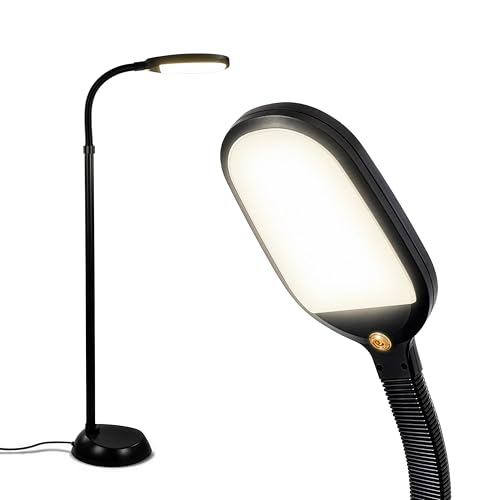
Guide
Reading light setup for low vision
Lamp position, brightness, color temperature and glare — the setup that makes print readable.
Read the guide →
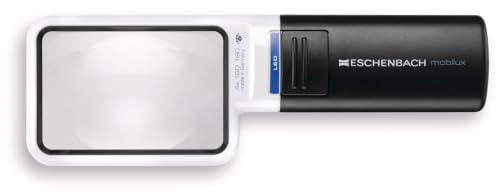
Best magnifier
Best magnifiers for low vision
Optical and electronic magnifiers compared for reading, labels and close work.
Read the guide →
Best for macular degeneration
Best electronic magnifiers for macular degeneration
Desktop and portable video magnifiers for central vision loss, judged on screen size, contrast modes and reading aloud.
Read the guide →
Best big-digit clock
Best big-digit clocks for seniors
Big-digit, day-of-week and talking clocks, picked by whether the problem is eyesight, hearing or memory.
Read the guide →
Best large print keyboard
Best large print keyboards for seniors
Large print keyboards compared on letter size, contrast, backlighting and key feel - with the free settings to try first.
Read the guide →